

The Jungle Patrol is one of the most enduring institutions in the Phantom comic strip, playing a critical role in maintaining peace and justice in the fictional nation of Bangalla. Created by Lee Falk, the Jungle Patrol serves as an elite law enforcement unit tasked with protecting the jungle and its people from criminals, pirates, poachers, and other threats. Beyond its public function, the patrol is deeply connected to the Phantom himself, who operates as its secret commander.
The Jungle Patrol was founded by the 6th Phantom, who sought to combat lawlessness in the Bangallan jungle. At the time, the region was plagued by bandits, slavers, and rogue mercenaries who exploited its remote and untamed terrain to escape justice. Recognizing the need for a dedicated force to uphold order, the 6th Phantom established the Jungle Patrol as a paramilitary organization capable of navigating and operating within the dense jungle environment.
Founded in 1664, the story commences with a notorious pirate known as Red Beard, who presided over the pirate city of Sanloi. The Phantom, intent on terminating the rampant pirate activities within the city, issued a formal challenge to Red Beard for a duel.
Initially, the Phantom had to contend with three of Red Beard’s henchmen: Bart, Salla, and Crusher. He engaged Bart in an axe combat, faced Salla or Guillaum in a duel, and confronted Crusher in a fistfight. Ultimately, he came face to face with Red Beard. The confrontation remained evenly matched for an extended period until they boarded Red Beard’s vessel. There, the Phantom lost his rapier but managed to disarm Red Beard using a stool.
The Phantom delivered a significant blow to Red Beard, causing him to fall to the ground. Following this defeat, the pirates were compelled to comply with the Phantom’s command. The Phantom instructed Red Beard and his three aides to each select their 25 most capable men. These individuals subsequently constituted what is now recognized as The Jungle Patrol.
The Jungle Patrol was initially composed of former criminals and mercenaries who were offered amnesty in exchange for their loyalty and service. This unique approach allowed the Phantom to harness their skills and knowledge of the jungle, turning them into an effective and disciplined unit. Over time, the patrol grew in size and professionalism, earning a reputation as a formidable force for justice.
The Jungle Patrol is a highly organized unit, with its headquarters located in a well-fortified base in Bangalla. Its members are skilled in various disciplines, including tracking, combat, and jungle survival, making them well-suited to their mission of maintaining law and order in one of the most challenging terrains in the world.
The patrol operates with a strict chain of command, with its officers and soldiers adhering to military-style discipline. Their operations include protecting villages, combating poaching and illegal logging, and suppressing pirate activity along Bangalla’s coastline. Despite its military structure, the Jungle Patrol also engages in humanitarian missions, such as disaster relief and medical aid, further solidifying its role as a protector of the Bangallan people.
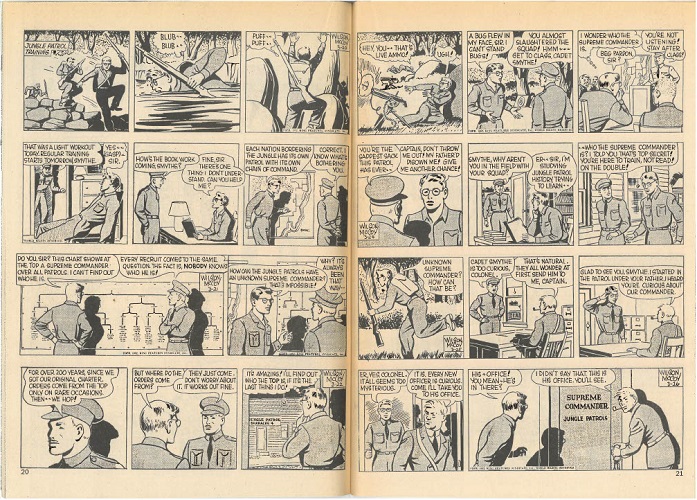
One of the Jungle Patrol’s most fascinating aspects is its secret connection to the Phantom. While the patrol is publicly led by a figure known as the ‘Colonel’, the true commander-in-chief is the Phantom himself. This secret has been maintained across generations, with each Phantom assuming control of the patrol as part of their mission to protect Bangalla and fight evil.
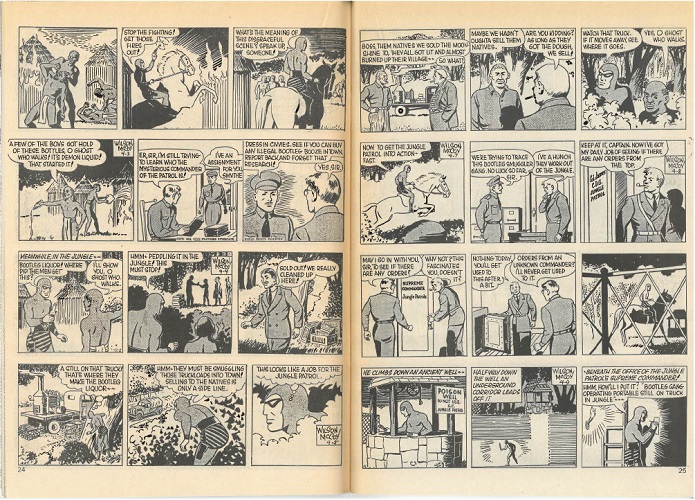
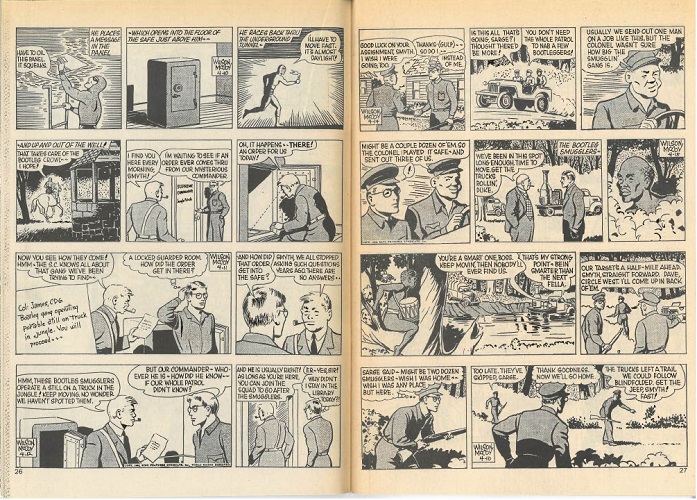
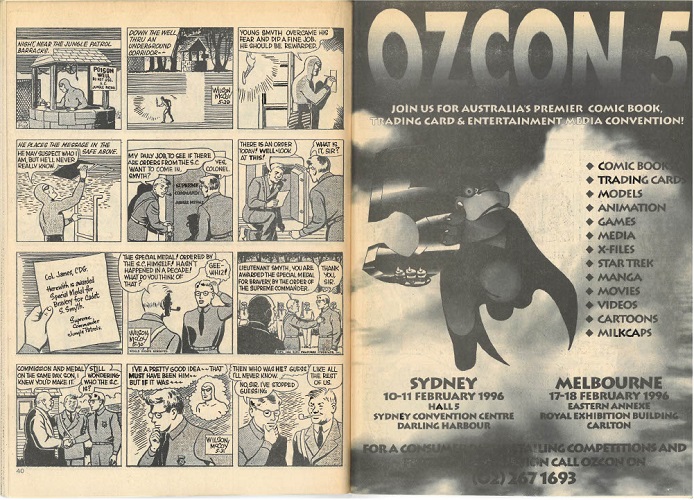
The Phantom’s command is facilitated through a hidden system. At the heart of this system is disused water well which conceals a hidden passage in the Jungle Patrol’s headquarters, opening up to a safe housed in the ‘Supreme Commander’ office, which only the Phantom can access from the base of the safe. This concealed communication point allows the Phantom to issue orders and receive reports without revealing his identity. Patrol members deposit messages into the safe, which are retrieved by the Phantom. This arrangement ensures that the Phantom can guide the patrol’s actions while maintaining the secrecy of his dual identity.


The Phantom’s leadership provides the patrol with an edge in dealing with extraordinary threats. His knowledge of the jungle, unparalleled combat skills, and access to centuries of wisdom from his ancestors allow him to devise strategies that would be beyond the capabilities of conventional forces.
The legacy of the Phantom is deeply intertwined with the Jungle Patrol. Through his secret command, the Phantom has ensured that the patrol remains true to its founding principles of justice and protection. Each generation of the Phantom has contributed to the patrol’s development, adapting it to the changing needs of Bangalla while preserving its core values.
As of the latest stories of the Phantom comic strip, the Jungle Patrol continues to be publicly led by the Colonel, a capable and dedicated officer who manages the patrol’s day-to-day operations. The Colonel is unaware of the Phantom’s true identity but respects and trusts the guidance provided through the well.
Behind the scenes, the current Phantom, the 21st in the line, serves as the secret commander. His dual role as a masked hero and the leader of the patrol allows him to tackle threats both overtly and covertly, ensuring the safety of Bangalla and its people.
The Flag

The flag of The Jungle Patrol prominently features The Good Mark, rendered in gilded hues against a blue backdrop, accompanied by the year 1664. In each corner, the letters S, C, and M appear in red, representing the motto ‘Stamus Contra Malo,’ which translates to ‘We Stand Against Evil‘.
Since the demise of the 14th Phantom in 1831, a victim of betrayal from an individual who had pledged allegiance to The Singh Brotherhood, the true identity of the Jungle Patrol’s commander has remained an enigma.
Currently, the Jungle Patrol receives a multitude of applications from across the globe annually; however, only ten applicants are granted admission each year. The selection process involves stringent physical and psychological evaluations. William Weeks served as colonel of the Jungle Patrol for an extended period before his retirement, at which point Worobu assumed command. In instances where the Phantom wished to convey messages to Worobu, a covert passageway was utilized, leading from a well directly into the Jungle Patrols headquarters.
The Jungle Patrol
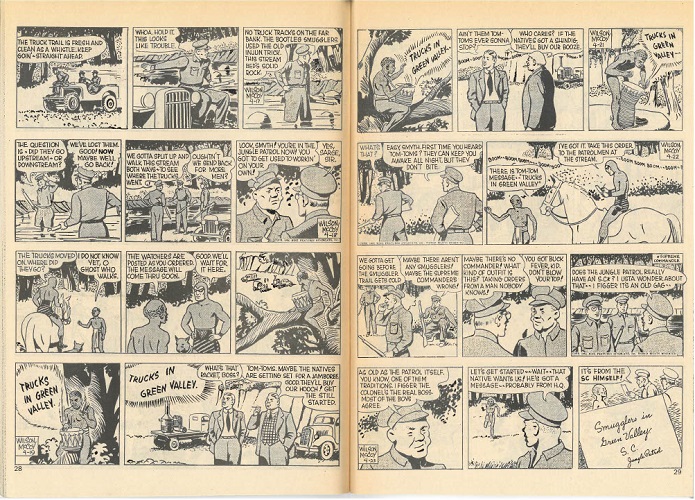
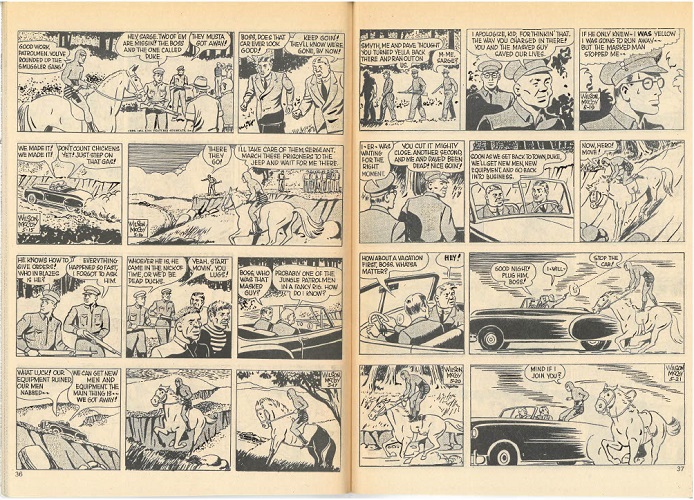
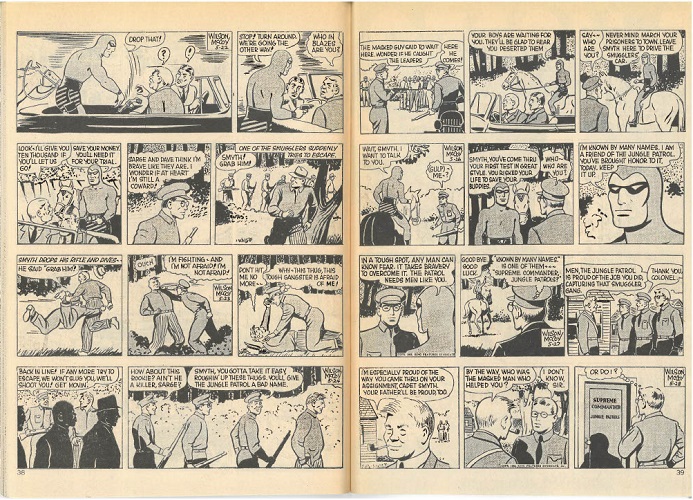
Story by Lee Falk and illustrated by Wilson McCoy.
The Jungle Patrol story was first published as a daily comic strip in newspapers from the 17th of March 1952 until the 31st of May 1952.




 thephantom.fan