

Sala is one of the most intriguing and multifaceted characters in The Phantom universe. Introduced as an adversary but later portrayed with shades of complexity, Sala embodies the classic trope of a femme fatale while evolving into a significant figure in The Phantom’s lore. Her story arc highlights themes of redemption, loyalty, and the fine line between heroism and villainy.
Although Sala made a brief appearance in the first Phantom daily newspaper story The Singh Brotherhood, released in February 1936, it wouldn’t be until the following newspaper story that we would learn more about Sala, heavily featured in The Sky Band, which ran from the 9th of November 1936 thru till the 10th of April 1937. Written by Lee Falk and illustrated by Ray Moore, this early adventure introduced readers to a daring and dangerous group of air pirates known as the Sky Band. These female aviators were led by Sala, a cunning and charismatic leader who used her intelligence, charm, and ruthlessness to command her crew and strike fear into her enemies. Sala’s introduction was a landmark moment, showcasing a strong female antagonist in an era when comic strips predominantly featured male villains.
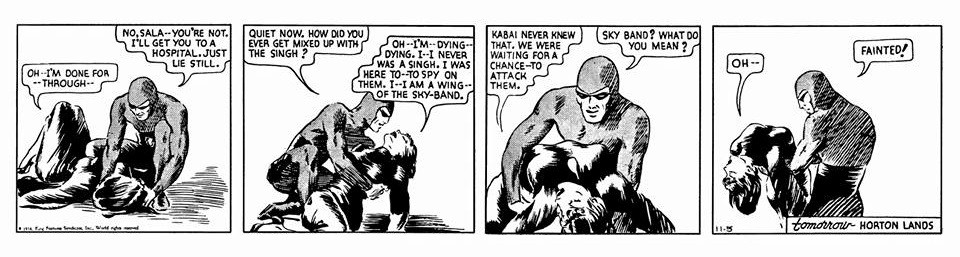
In The Sky Band, Sala’s beauty and intellect were matched only by her ambition. Her encounters with the Phantom were charged with tension, as she admired his bravery and resourcefulness even while opposing him. This duality set the stage for a complex relationship that would evolve over subsequent stories.
Sala’s relationship with the Phantom is a compelling mix of admiration, rivalry, and latent romantic tension. While initially an antagonist, Sala’s respect for the Phantom’s moral code and unyielding courage grew over time. Their dynamic reflected a recurring theme in the Phantom’s universe: the redemption of those who cross paths with The Ghost Who Walks.
In later stories, Sala transitions from a villain to an ally, though her motivations often remain ambiguous. Her connection to the Phantom is marked by moments of vulnerability and trust, suggesting an unspoken bond between them. This nuanced relationship added depth to her character and highlighted the Phantom’s ability to inspire change even in his adversaries.

Sala was even featured in the 1996 release of the Phantom movie, an Australian-American superhero film directed by Simon Wincer, starring Billy Zane as the Phantom. In this adventurous tale, the part of Sala was played by the talented Catherine Zeta-Jones, who brought depth and charm to the role, embodying a strong and resourceful character that captivated audiences. The film itself was an adaptation of the classic comic strip created by Lee Falk, and it sought to revive the adventurous spirit of the original story while introducing a new generation to the heroic exploits of the Phantom, who fights against evil in the fictional country of Bangalla.
Sala remains a fan-favorite character, not only for her striking debut in The Singh Brotherhood, but also for her enduring presence in Phantom lore. Her evolution from an enemy to a reluctant ally reflects the broader themes of redemption and moral complexity that underpin the Phantom’s stories. Sala’s character demonstrates that even those who walk a dark path can find the light, provided they encounter the right guide.
Through her intelligence, bravery, and layered personality, Sala stands as a testament to Lee Falk’s ability to create compelling and memorable characters. She serves as a reminder that in the Phantom’s world, every character, whether hero or villain, contributes to the rich tapestry of adventure, danger, and humanity.
 thephantom.fan