
The VI Salón Internacional del Cómic / Ciudad de Oviedo (translating to the 6th International Comic Fair / City of Oviedo) was held in the city of Oviedo, Asturias, Spain in November 1989. This should not be confused with the Barcelona International Comic Fair, which had its sixth edition earlier on the same year. The Oviedo Salón is historically recognized for its intellectual focus, managed by the Principado de Asturias Comic Convention Club (International Comic Fair of the Principality of Asturias), and is primarily the host of the prestigious Haxtur Awards, setting it apart as a critically-oriented event in the Spanish comic landscape.
The Salón Internacional del Cómic del Principado de Asturias is one of the oldest comic conventions in Europe, predating even the major Italian and French festivals.
Origins and Early Stages (Gijón, 1972-1979)
The convention began in 1972 in the city of Gijón, Asturias. It was initially conceived as a parallel activity of the Gijón International Film Festival, intended to help relaunch the film event during a period of weakness. It quickly gained international relevance the following year. However, the early years were unstable:
- Interruption: The event was not held in 1977 and experienced another gap between 1980 and 1983 due to financial difficulties and changing organizers.
- Faustino Rodríguez Arbesú: A central figure and scholar in Spanish comics, he became involved as an advisor in 1973, though he later stepped away before returning to lead the event.
The Oviedo Years and the Haxtur Awards (Oviedo, 1984-1989)
The convention was officially re-established and moved to the city of Oviedo in 1984. This era was crucial for establishing the event’s critical identity. In 1985 (though the idea was proposed earlier), the Haxtur Awards were created and delivered for the first time at the Salón in Oviedo. This is the period that cemented the convention’s focus on critical quality and attracted major international authors.
Later Stages and the Final Closure (Gijón and Asturias, 1990-2014)
After 1989, the event returned to Gijón, although its full title, Salón Internacional del Cómic del Principado de Asturias, reflects its regional scope. Faustino Rodríguez Arbesú directed the Salón from 1984 onwards, often alongside the influential comic magazine he founded, El Wendigo.
Despite the sustained critical acclaim and the legacy of the Haxtur Awards, the event faced recurring financial difficulties, culminating in its final closure in September 2014, after 42 years of history. Its closing was a major loss for the European comic circuit, ending its tenure as one of the continent’s most critically distinguished comic conventions.
The Haxtur Awards (Premios Haxtur) was one of the most prestigious and internationally respected comic awards in Spain, particularly known for their focus on quality, critical depth, and the history of the medium.
The Haxtur Awards were established in 1985 by the editorial board of the Asturian comic magazine El Wendigo. They are presented annually at the Salón Internacional del Cómic del Principado de Asturias (International Comics Convention of the Principality of Asturias), which has been held in both Oviedo and Gijón. The award takes its name from a heroic fantasy character, Haxtur, created by the acclaimed Spanish artist Víctor de la Fuente in the early 1970s. This origin highlights the awards’ emphasis on Spanish comic history while also championing international works.
Unlike some other comic fairs that are heavily influenced by sales or fan popularity, the Haxtur Awards are primarily decided by a jury, emphasizing critical merit and artistic quality in the works published in Spain each year. This distinction has allowed them to recognize groundbreaking international works early on, including titles that have since become foundational graphic novels, such as Alan Moore and Dave Gibbons’ Watchmen and Frank Miller’s Batman: The Dark Knight Returns, both of which won the Best Long Story award in the late 1980s.
The awards feature several categories that recognize the specific elements of comic creation:
- Mejor Historia Larga (Best Long Story/Comic Strip)
- Mejor Historia Corta (Best Short Story/Comic Strip)
- Mejor Guión (Best Script)
- Mejor Dibujo (Best Drawing)
- Mejor Portada (Best Cover)
In addition to these competitive prizes, the Haxtur Awards include several special, non-competitive honors:
- Autor que Amamos (Author That We Loved): This is the prestigious lifetime achievement award. It is given as a tribute to the career of a renowned creator.
- Finalista más Votado (Finalist with the Most Votes): An Audience Choice Award selected by the attendees from the nominated finalists.
- Premio Especial John Buscema (John Buscema Special Award): Dedicated to those who have made extraordinary contributions to the medium and its recognition as an art form.
The Haxtur Awards have consistently recognized both Spanish creators and the finest international talent, giving them a respected place on the global comic award circuit. Winners have included legends like Will Eisner, Jim Starlin, Richard Corben, and George Pérez, alongside influential European and Japanese creators. The event’s commitment to celebrating both new work and the careers of established masters, solidifies its role as a key barometer for critical excellence in the world of sequential art.
Lee Falk, the legendary American writer, playwright, and creator of the Phantom and Mandrake the Magician, was the guest of honor for a very specific reason. His attendance marked his acceptance of one of the highest honors conferred by the organization: the Premio Haxtur al Autor que Amamos (Haxtur Award to the Author That We Loved). This award is a lifetime achievement recognition, celebrating his profound and lasting influence on the medium, having scripted two of the longest-running and most influential comic strips in history. His presence in Oviedo underscored his status as a foundational figure in global comic storytelling.
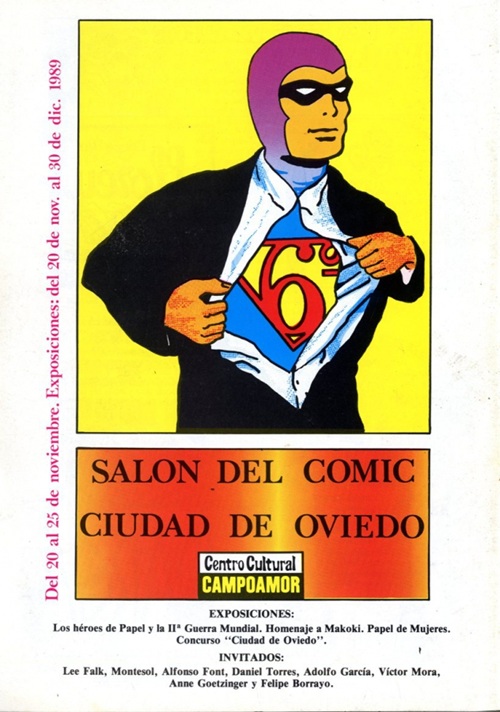
An image of the Phantom is found on the promotional poster of that year, highlighting the dates of the event, plus the various comic book creators to attend, with Lee Falk’s name found amongst the attendees. A number six is illustrated on the Phantoms chest indicating the events sixth year.
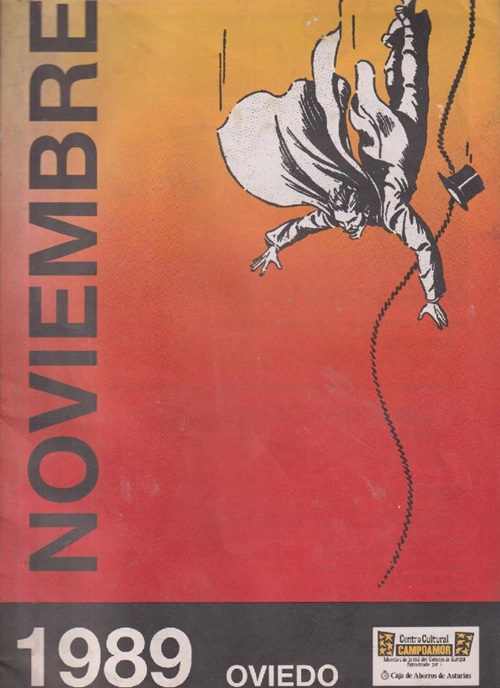
An event program was also published highlighting the various events and necessary information for the 1989 VI Salón Internacional del Cómic event. The program contains 62 pages measuring 32cm x 21.5cm, with Mandrake the Magician featured on the front cover.
The 1989 Haxtur Awards ceremony was a star-studded affair, reflecting its high international profile by honoring other major figures in the industry. Alongside Falk’s career award, key competitive prizes were distributed to some of the most prominent creators of the era. For instance, Alan Moore was recognized for Best Script, and artist Brian Bolland won for Best Drawing, specifically for his work on the critically acclaimed graphic novel ‘Batman: The Killing Joke’. The Best Long Story award went to George Pérez for Wonder Woman.
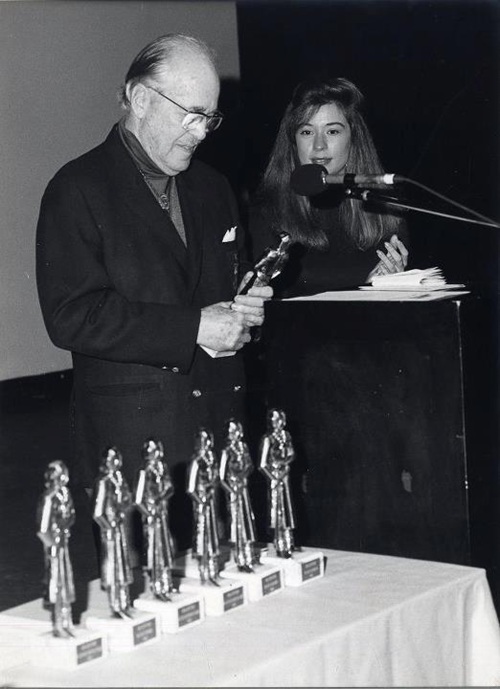
Lee Falk can be seen below accepting his Premio Haxtur al Autor que Amamos (Haxtur Award to the Author That We Loved) award.
The recognition of such international titans, from the foundational work of Lee Falk to contemporary masterpieces like The Killing Joke, solidified the Oviedo Salón’s reputation as a serious platform for the Noveno Arte (Ninth Art). While the Barcelona Salón focused on the industry and popular commerce, the Oviedo event established itself as a place for critical analysis and retrospective celebration, providing a meaningful tribute to the global history and artistry of comics.
Lee Falk’s appearance in Oviedo allowed Spanish fans to meet the creator of the Phantom, and his acceptance of the Premio Haxtur al Autor que Amamos (Haxtur Award to the Author That We Loved) award remains a significant moment in the history of Spanish comic conventions, highlighting the high regard with which the works of the Phantom and Mandrake the Magician are held among critics and dedicated readers in Spain.
 thephantom.fan