
Aircraft Nose Art is usually found on the front fuselage of an aircraft, taking the form of an image or pattern. Depending on the skills of the artist applying the illustration, the art seen cover a large spectrum from basic to highly detailed.
Nose Art is generally found on military aircrafts, with the practice believed to date back to the 1910’s, with Italian and German pilots credited to be amongst the first to decorate their planes in this way.
The reason for the Nose Art is believed to have been popular during war times, as it sets a particular aircraft and pilot aside from the next, with military vehicles traditionally mirroring each other with no real distinguishable features. It was also a great way for pilots to quickly distinguish between those who are friends and those who are enemies in the air.
The Phantom is featured as Nose Art on a USAAF aircraft, a Consolidated C-87-CF Liberator Express aircraft flying the air transport route between Brazil and North Africa in 1943. The photo was taken by Thomas McAvoy and is held by the LIFE Magazine Archives.
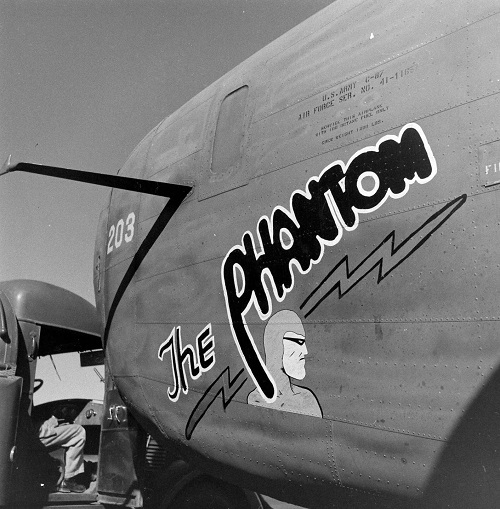
Consolidated C-87-CF Liberator Express Aircraft
The Consolidated C-87-CF Liberator Express aircrafts were built in limited numbers, a total of 287 built. It was designed in 1942 as a heavy cargo and personnel transport, offering longer range and improved high-altitude performance compared to the C-47 Skytrain, which was widely used by the United States Army Air Forces during that time.
The initial C-87 prototype was derived from a damaged B-24D (serial number 42-40355), crashed at Tucson Municipal Airport #2 on the 17th of February, 1943. Tragically, six Consolidated Aircraft employees who were passengers on board lost their lives, while several others sustained injuries.
Modifications were made to the prototype, converting it into a transport configuration. These modifications included removing the gun turrets and other armament, reinforcing the cargo floor, and installing a hinged metal cap in place of the glassed-in bombardier compartment. A cargo door was added on the port side of the fuselage, and windows were incorporated along the fuselage’s sides.
The C-87 could be configured to transport personnel or cargo by installing removable seats and racks. In its final form, the aircraft could accommodate approximately 20 to 25 passengers or carry a cargo weighing up to 12,000 lbs. Due to production limitations and shortages during the war, many C-87 aircraft were equipped with turbosuperchargers that provided lower boost pressure and power compared to those used in B-24s intended for combat purposes, resulting in compromised ceiling and climb rates.
Thomas McAvoy
LIFE debuted in 1936 with four staff photographers—Margaret Bourke-White, Alfred Eisenstaedt, Peter Stackpole and Thomas McAvoy—all now regarded as masters. A newspaper veteran before joining the magazine, McAvoy (1905-1966) specialized in candid news shots. He was nearly alone in his approach, as the uncontrived portrait was then revolutionary. McAvoy was the complete pictorial chronicler of Franklin D. Roosevelt; one series of natural shots so unnerved the President that the White House barred further unposed pictures. McAvoy took the first photo of the Senate in session, prompting a rule banning candid Senate shots. The conventions of journalism that restrain photographers today did not hold McAvoy back. He once hired a limousine and improvised a pass to sneak into a high-security cold-war diplomatic reception. He would employ all kinds of trickery—disguises, teeny cameras snapped discreetly—to get an honest picture.
Extract from The Great LIFE Photographers.
 thephantom.fan