
The newspaper Haber (News), particularly known in the 1930s as Haber Akşam Postası, holds a distinct place in the history of the Turkish press, serving as a key media instrument during the formative years of the Republic. In an era dominated by the Republican People’s Party (CHP) and the foundational principles of Kemalism, the press was generally utilized to disseminate and reproduce the values of the new nation-state, and Haber was no exception. It functioned within a media ecosystem tasked with promoting secularism, modernization, and the national identity championed by Mustafa Kemal Atatürk. While its content provided general news, its ideological function was crucial: to educate the public (halk) and celebrate the progressive direction set by the intellectual elite (münevver) of the Turkish Republic, often framing this progress in sharp contrast to the perceived stagnation of the Ottoman past.
Beyond its conformist role in supporting state ideology, the publication’s history also reflects unique aspects of labor relations within the nascent Turkish newspaper industry. Notably, an earlier iteration of a newspaper named Haber was famously published by striking typesetters in 1923. This event marked one of the few instances in early Turkish press history where workers, in conflict with their employers, used the medium of the newspaper itself to fight for their interests and rights. Although the Haber Akşam Postası of the 1930s was an established publication aligned with the republican order, the very name carries a subtle legacy of journalistic struggle and the push for employee protections, underscoring the dynamic and sometimes contentious nature of the publishing business during the transition from Empire to Republic.
The political context surrounding the paper in late 1938 is particularly poignant due to the death of Atatürk on the 10th of November 1938. In this delicate time, publications like Haber would have been navigating a period of both national achievement and profound uncertainty regarding the leadership transition to İsmet İnönü. The editorial stance during this period would have focused heavily on national unity, projecting stability, and upholding the legacy of the founder while carefully managing public discourse during a highly sensitive succession. The paper thus provides historians with a valuable snapshot of the public narrative in Turkey as it stood at a critical historical crossroads.
Ultimately, Haber Akşam Postası serves as an important primary source for understanding the social, political, and cultural currents of the early Republican period. Its columns documented not only international and domestic events, such as the rising regional tensions of the 1930s, but also the daily life and cultural transformation taking place in Istanbul and Ankara. By reviewing its pages, researchers can analyze the rhetorical strategies used to mobilize public support for policies like economic etatism and the Turkification process. The newspaper’s content demonstrates how the press was actively engaged in constructing the modern Turkish citizen and solidifying the cultural and political foundations of the Republic in the decades following its establishment.
The Phantom is traditionally published under the title of ‘Kızılmaske’ in Turkey, which translates to ‘Red Mask’. However, in this very early edition to publish the Phantom in Turkey, he’s seen under the title of ‘Kızıl gölge’, which translates to ‘Red Shadow’.
The Phantom was originally introduced as an upcoming feature in Haber Akşam Postası newspaper on the 10th of November 1938 via a small notification by the publisher, a day prior to the Phantom comic strip going to print in the newspaper. This notification can be seen below.
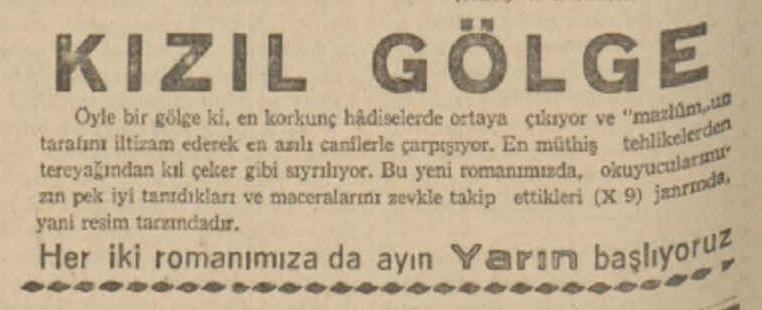
Translated to English, the notification reads.
THE RED SHADOW
A shadow that appears in the most terrifying events and, “oppressed,” clashes with the most vicious murderers, demanding their favor. It escapes the most terrifying situations with ease. This new novel is in the genre, the pictorial style, of which readers are well acquainted with dangers and whose adventures they follow with pleasure (X 9).
We begin both of our novels tomorrow.
The Phantom comic strip began its publication in Haber Akşam Postası newspaper on the 11th of November 1938. The story that commenced in this edition is the inaugural daily Phantom story, written by Lee Falk and illustrated by Ray Moore, titled ‘The Singh Brotherhood’. This classic tale marks the first instance of the Phantom’s appearance in a U.S. newspaper, which was published from the 17th of February 1936, through till the 7th of November 1936.
The page containing the first appearance of the Phantom comic strip in Haber Akşam Postası can be seen below, believed to of been sourced from Italian publishers, hence for the reference to a ‘Red’ Phantom.

The information presented by the publisher on the Phantom found to the left of the comic strip story, translated from Turkish to English reads:
Our new novel:
RED SHADOW!
Today we started a new movie novel. This novel, titled “Red Shadow,” is a beautiful adventure story that tells the world’s most exciting adventures through pictures alone.
You can see the first part of this novel, which we strongly anticipate you will follow with pleasure, on this page today. We will continue with the fifth page every day, starting from first half.
Who is the red shadow?
Let’s introduce the hero of our new novel: In Bengal, a mysterious figure excites the curiosity and curiosity of honest men and makes bandits and murderers tremble with fear: “Red shadow!”
This man is a protector of the weak and the helpless, an enemy of bandits and murderers. He appears at the most unexpected times, sometimes appearing on one side of my world, sometimes on another, running everywhere to combat evil, reaching everywhere.
He always works alone, has no assistants, and even seeks the help of the police. Some suspect he has a history that makes him wary of the police.
But no one knows who he is, and no one has even seen his face. The “Red Shadow” is the most enigmatic hero history has ever recorded.
Be sure to follow our serialization.
In Haber Akşam Postası newspaper published on the following day, the 12th of November 1938, the Phantom comic strip continues, with the Phantom seen more prominently by readers.
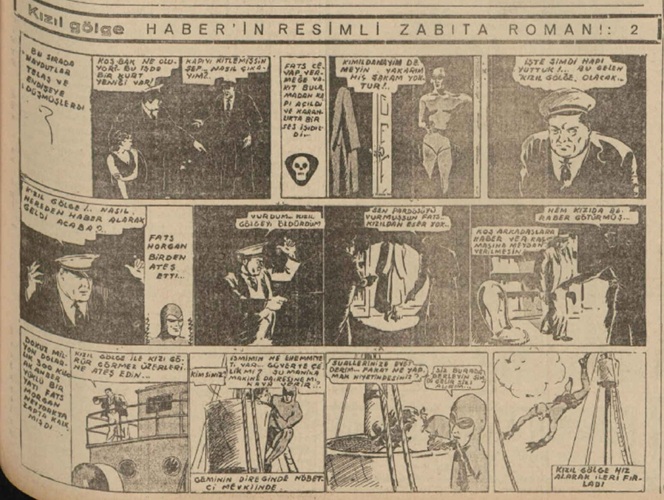
In Haber Akşam Postası newspaper published on the 16th of November 1938, a small update notification is published, notifying readers of the Phantom comic strip story progress. This update notification can be seen below.
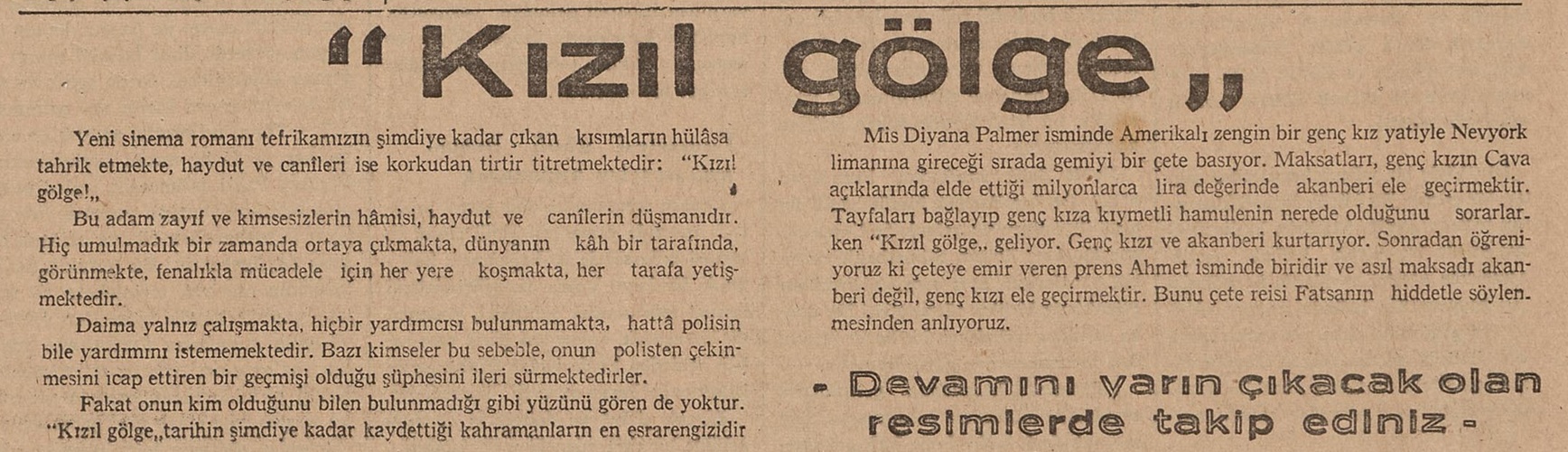
Translated to English, the update notification reads.
“Red Shadow”
The summary of the parts of our new cinema novel serial that have been published so far is inciting and makes bandits and murderers tremble with fear: “Red shadow”!
This man is a protector of the weak and helpless, an enemy of bandits and murderers. He appears at the most unexpected times, sometimes in one corner of the world, and runs everywhere to combat evil, reaching everywhere.
He always works alone, has no assistants, and refuses to even ask for police assistance. Some suspect he has a history that makes him wary of the police.
But no one knows who he is, nor has anyone seen his face. “The red shadow is the most mysterious of all the heroes that history has ever recorded”.
A wealthy American woman named Miss Diana Palmer is about to enter the port of New York when a gang raids the ship. Their goal is to seize the millions of lira worth of cash the woman has acquired off the coast of Java. The crew ties her up and asks her where the precious cargo is. “The red shadow is coming”, she says, “and rescues the young woman and the cash”. We later learn that the gang’s command is given by a prince named Ahmet, whose true goal is not to seize the cash, but to seize the young woman. We understand this from the gang leader Fatsa’s angry words.
– Stay tuned for more pictures to come tomorrow –
 thephantom.fan