
The Megavore fanzine series stands as a notable, albeit brief, chapter in the history of science fiction and popular fiction fandom. Edited and published by the dedicated collector and bookseller J. Grant Thiessen through his imprint, Pandora’s Books, Megavore emerged in the early 1980s as a vital resource for enthusiasts interested in the bibliographic and historical aspects of speculative and pulp literature. Its existence, though spanning only a few issues under that specific title, represented an evolution of earlier fan efforts to document and celebrate the rich tapestry of genre fiction.
The genesis of Megavore can be traced back to Thiessen’s prior publication, ‘The Science-Fiction Collector’. This foundational fanzine laid the groundwork for the in-depth bibliographic research and critical commentary that would characterize its successor. A pivotal moment occurred with issue #9 of ‘The Science-Fiction Collector’, published in June 1980. At this juncture, it formally merged with ‘Age of the Unicorn’, another serious fanzine devoted to various facets of pulp fiction, notably edited by Michael Cook.
This amalgamation led to the combined magazine being retitled ‘Megavore: The Journal of Popular Fiction’. This change reflected a broader scope, aiming to encompass a wider array of popular culture beyond just science fiction. However, this new title proved temporary; after a run of issues under the Megavore banner (specifically issues #9 through #13, with #10 appearing in August 1980, #12 in December 1980, and #13 in March 1981), the publication reverted to its original name, ‘The Science Fiction Collector’, starting with issue #14 in May 1981, albeit without the hyphen.
The series ultimately ceased publication around 1981, with its final issue (#15, July 1981) being a significantly larger, tabloid-format printing of 11,000 copies, distributed in conjunction with Thiessen’s Pandora’s Books catalog and at the 1981 World Science Fiction Convention. This cessation was largely attributed to Thiessen’s increasing commitments to his burgeoning mail-order business and family life.
The content of Megavore was a treasure trove for collectors and scholars of genre fiction. Its primary focus remained bibliographic, offering meticulously compiled checklists and insightful articles on various aspects of paperbacks and professional magazines. For instance, issue #10 featured a comprehensive checklist of Lancer science fiction and fantasy titles, compiled by William J. Denholm III. Other notable contributions included Tom Johnson’s article on Corinth/Regency pulp hero reprints and Darrell Schweitzer’s index to the ‘Not at Night’ series.
The fanzine also delved into specific characters and authors, with Nick Carr contributing an article on Dusty Ayres and his Battle Aces in issue #10. Subsequent issues continued this tradition, with Megavore #12 featuring bibliographies on James H. Schmitz and John Varley, alongside ‘The Story of The Phantom’. Issue #13 provided further scholarly material, including an article on ‘The Top Ten Spider Novels’ by a syndicate of writers including Will Murray and Bob Sampson, a bibliography of Jack Williamson by Uwe Luserke, and an exploration of Arthur Conan Doyle’s Professor George Edward Challenger by Dana Martin Batory.
Beyond these detailed studies, Megavore also offered broader commentary and industry insights. Issue #9 (the first to be titled Megavore) included an interview with John Nanovic, the esteemed editor of classic pulps like Doc Savage and The Shadow, conducted by Albert Tonik. The fanzine regularly featured reviews of books and other fanzines, along with J. Grant Thiessen’s own editorial remarks and letters from readers. The inclusion of advertising, sometimes in a dedicated center section, also provided a glimpse into the fan and collecting market of the era. The consistent quality of its content and the dedication of its contributors, such as Will Murray, Bob Sampson, Michael Avallone, and Dana Martin Batory, solidified its reputation as a serious and valuable publication within the fan community.
Physically, Megavore issues typically maintained a quarto size (roughly 8.5 x 11 inches) and comprised around 48 pages, presented in stapled pictorial wrappers. This consistent format allowed for a substantial amount of content in each issue. The final, larger tabloid issue marked a departure, perhaps an attempt to reach a wider audience before its eventual discontinuation. Despite its relatively short run under the Megavore title, the series, and its lineage through ‘The Science-Fiction Collector’, played a crucial role in preserving and disseminating information about popular fiction, contributing significantly to the historical record and the ongoing discourse within the fan community. Its legacy lies in its commitment to detailed research and its role as a bridge for enthusiasts seeking to deepen their understanding of the genres they loved.
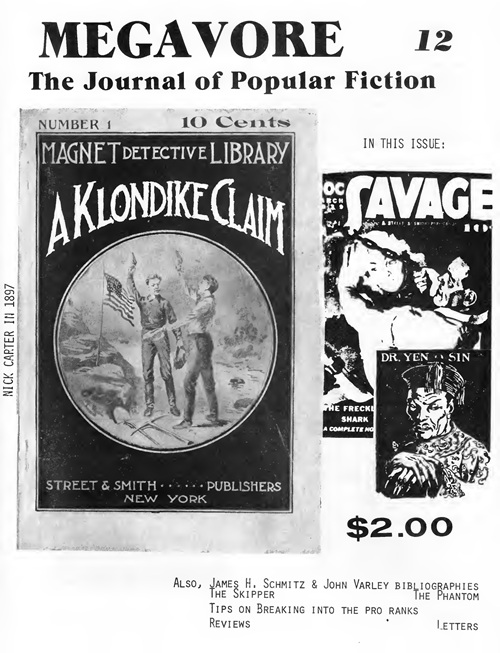
Megavore issue number 12, with the subtitle ‘The Journal Of Popular Fiction’, was released in December 1980 containing 46 black and white pages measuring 8.5” x 11”. The front and back covers can be seen below.

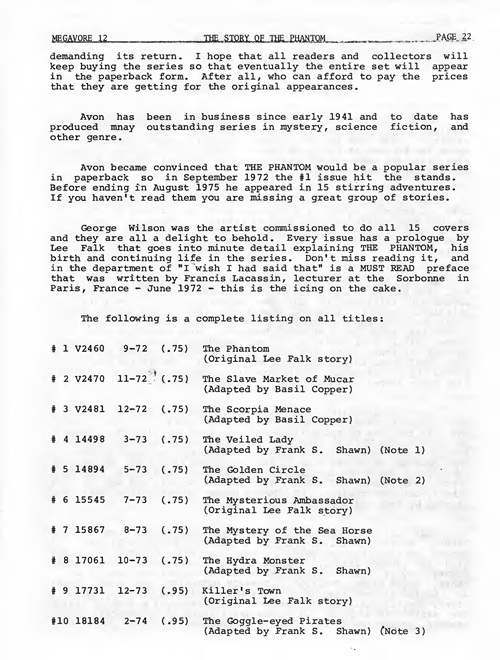
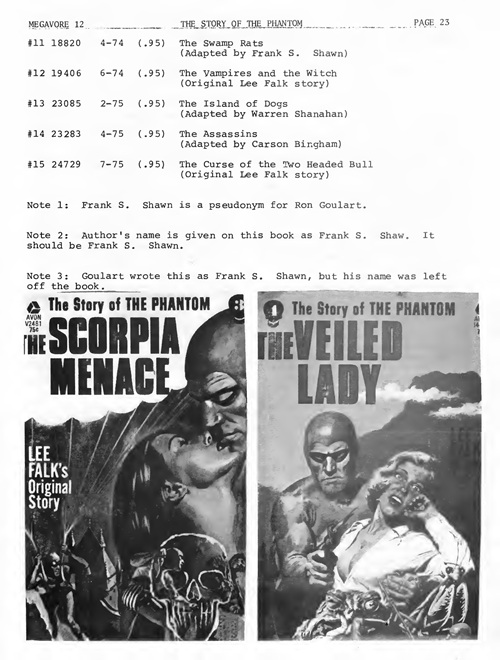
An article appears in this edition titled ‘The Story Of The Phantom’ by Melville C. Hill, commencing on page 21 and spanning three pages, provides a detailed exploration of the Phantom’s creator, Lee Falk, as well as an overview of the storybooks published by Avon in the United States beginning in 1972, which encompass a total of 15 editions.
These three pages can be seen below.

 thephantom.fan