
Ciao 2001 was a highly influential Italian music magazine, a staple for generations of music enthusiasts in Italy. Its history is marked by periods of immense popularity, a hiatus, and a recent revival, reflecting the changing landscape of music journalism.
Ciao 2001 was renowned for its comprehensive coverage of the Italian and international music scene. Its pages offered in-depth articles, interviews with prominent musicians, album reviews, and news on concerts and tours. From legendary rock acts like Frank Zappa, with multiple features and reviews throughout the years, to emerging pop stars, the magazine aimed to keep its readers informed about all aspects of popular music. It also provided a platform for critical discourse, offering insightful analysis of musical trends and cultural phenomena. Beyond music, earlier issues, particularly in its formative years, also delved into youth culture, fashion, and cinema, making it a broader cultural touchstone for its young readership.
Throughout its various iterations, Ciao 2001 has been associated with different publishing entities. The current publisher, as of its recent revival, is Sprea-SpA. Earlier in its history, when it first emerged from the merger of ‘Ciao Amici’ and ‘Big’, it was published by Edizioni Libri e Giornali di Attualità s.r.l.
Its history can be delineated into various segments of revival and hiatus on an annual basis:
1969-1994
The magazine’s roots can be traced back to the late 1960s with the merger of two existing music magazines, ‘Ciao Amici’ and ‘Big’ (later ‘Ciao Big’). This union gave birth to ‘Ciao 2001’, with its first issue appearing in January 1969. Initially, the magazine had a strong political bent, particularly influenced by the social and political movements of 1968 in Italy. However, under the editorial direction of Saverio Rotondi towards the end of 1969 and into the 1970s, Ciao 2001 gradually shifted its focus to become primarily a music publication.
For many years, Ciao 2001 was published weekly and quickly established itself as the most widely circulated music magazine in Italy, particularly resonating with a young audience. While it initially focused on pop music, its scope expanded to encompass a broad spectrum of genres, including beat, rock, jazz, and folk. Beyond music, Ciao 2001 also featured columns dedicated to radio and television, theatre, art, and even psychology, reflecting a wider cultural interest among its readership. The magazine enjoyed massive success, especially throughout the early 1980s.
1994-1999
Despite its earlier triumphs, Ciao 2001 experienced a prolonged period of decline starting in the late 1980s and early 1990s. This decline ultimately led to its initial cessation of publication in January 1994, after releasing a total of 1202 issues.
1999-2000
After a break, Ciao 2001 made a comeback in 1999, resuming publication on a monthly basis from February to December of that year. In 2000, it briefly rebranded itself as ‘Ci@o’ for its final five issues before once again ceasing publication.
2023-Present
In a testament to its enduring legacy and the dedication of its former collaborators, Ciao 2001 was relaunched in December 2023 by Maurizio Becker and Renato Marengo, with the support of Sprea Editori. It is currently published as a bimonthly magazine, aiming to critically re-examine and celebrate the golden age of rock, singer-songwriter, and underground music from the 1960s to the 1980s.
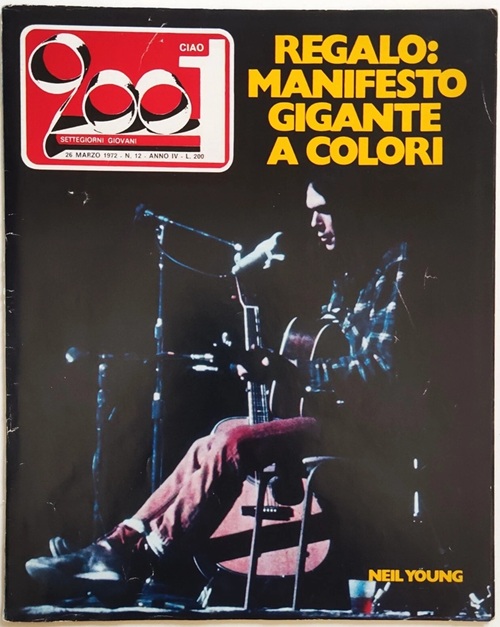
Ciao 2001, edition number 12 was published on the 26th of March 1972. In this edition, various well known muscians and artists are featured including Neil Young, Elton John, Deep Purple, Rory Gallagher and Francesco Guccini (an influential Italian singer-songwriter). The front and back covers of this edition can be seen below.

From page 54 thru to page 55 of this edition of Ciao 2001, an article authored by Armando Greco is presented, featuring the Phantom. The article is entitled ‘L’affascinante mondo dei fumetti, i Grandi Eroi: L’uomo Mascherato’, which translates to ‘The Fascinating World of Comics, The Great Heroes: The Masked Man’.
An image of the Phantom is presented at the beginning of the article on page 53, featuring an illustration by Mario Caria, wherein the Phantom is depicted in his customary Italian red costume, accompanied by his Italian title, ‘L’uomo Mascherato’.

 thephantom.fan