
Captain George, while originating from Canada, holds a significant place in the history of comic fandom and collecting across North America, including the USA. These influential fanzines were the brainchild of George Henderson, a dedicated Canadian comics dealer and collector who operated out of his Memory Lane bookshop in Toronto. Through various imprints, sometimes under Memory Lane Publication or in conjunction with the Vast Whizzbang Organization, Henderson created a vital forum for early comic enthusiasts, shaping the nascent collecting community.
The publication’s journey began in 1967 with ‘Comic World’, which initially focused on reprinting public domain comic strips like The Yellow Kid. Recognizing the growing interest, Henderson evolved the fanzine, retitling it ‘Captain George’s Comic World’ in 1968. The following year, in 1969, it was refined into ‘Captain George Presents’, signaling a broader scope beyond just strip reprints. Concurrent with these developments, 1968 also saw the debut of other related fanzines under Henderson’s umbrella, including ‘Captain George’s Whizzbang’ and the notably long-running ‘Captain George’s Penny Dreadful’, which would become a cornerstone of his publishing efforts.
The content of Captain George publications was a rich tapestry for collectors. A primary feature was the reprinting of rare early comic strips and Golden Age comic book material, alongside works by renowned magazine illustrators such as Alex Raymond and Frank Frazetta. This access to otherwise unobtainable material was invaluable for the burgeoning collector base.
Beyond reprints, the fanzines were packed with insightful articles, lively discussions, and columns dedicated to the current state of comics, profiles of historical comic figures, and explorations of related pop culture phenomena like films, pulps, and books. While not solely interview-driven like some later publications, they occasionally featured retrospective pieces or discussions pertaining to various creators.
As genuine fanzines of their era, Captain George publications were characterized by their often humble production values, typically printed on basic newsprint stock with remarkably low print runs, averaging around 500 copies per issue. Their physical dimensions varied considerably, from large tabloid sizes (11×17 inches) to more compact formats (7×10 or 8.5×11 inches), and page counts ranged widely from 16 to a substantial 88 pages, with some issues being double-numbered. Despite their unpolished appearance, their content was gold to a community starved for information and access to rare materials.
The longevity and profound influence of George Henderson’s fanzines cannot be overstated. The Captain George Presents’ series alone ran for at least 46 issues into 1971. Even more impressively, ‘Captain George’s Penny Dreadful’ proved to be his longest-running publication, continuing for over six hundred issues and concluding around 1982, consistently covering television, movies, comics, and paperback books. These publications were absolutely foundational in the late 1960s and early 1970s, predating the widespread establishment of the direct market and dedicated comic book stores. They were instrumental in fostering a collective identity among comic collectors, providing a crucial forum for discourse and a vital means for fans to acquire and learn about older, rare comic material. Today, due to their scarcity and immense historical significance within the landscape of comic fandom, these Captain George fanzines remain highly sought after by collectors worldwide.
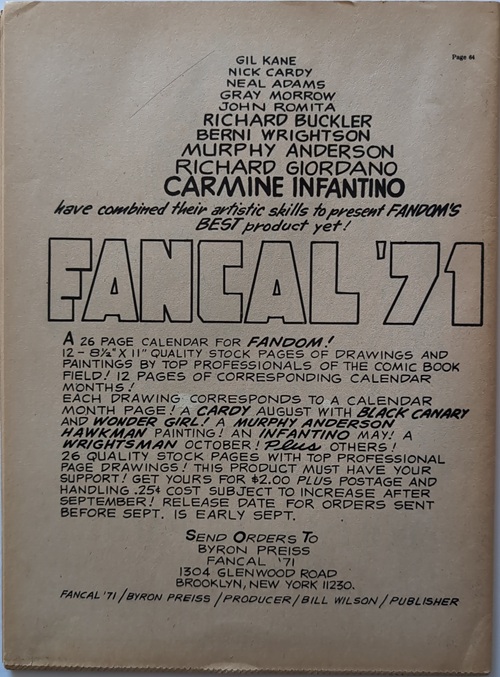
Captain George Presents, edition number 43-44 is double-numbered and was published in 1971. The tabloid style publication contains 63 black and white pages measuring 21cm x 28.5cm. It features, amongst other comic strip characters, those published by King Features Syndicate. The front and back covers can be seen below.

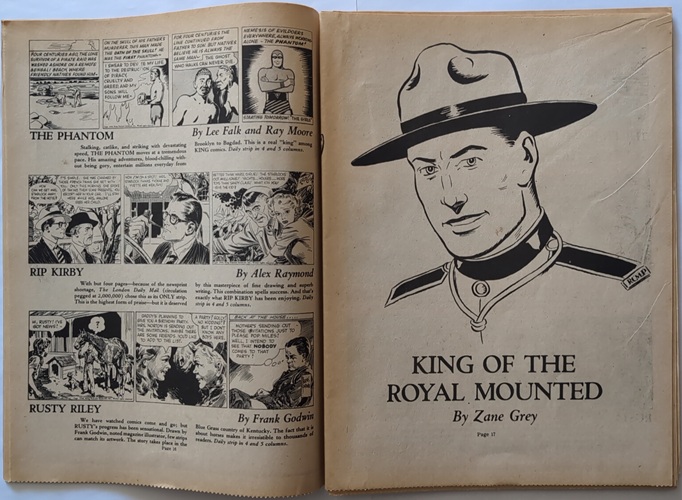
The Phantom is seen on two pages within this edition, on pages 11 and 16 as seen below. On page 11, a profile image of the Phantom illustrated by Ray Moore is found, whilst on page 16 is a comic strip illustrated by Wilson McCoy.

 thephantom.fan