
For generations, comic books were often dismissed as simple “funnies”—a distraction from “serious” reading. However, modern educational research and literacy experts agree: graphic novels and comic books are powerful learning tools with the ability to enhance literacy, boost comprehension, and foster critical thinking skills for students of all ages.
Comic books are not just a form of entertainment; they are a multi-modal medium uniquely suited to how the human brain processes information. Here are the core benefits of embracing comics in the classroom and at home.
1. The Gateway to Literacy for Every Reader
One of the most profound benefits of the medium is its power to transform reluctant readers. Traditional texts can be intimidating, presenting vast, unbroken blocks of words. Comics, conversely, provide a supportive visual scaffold:
- Low Intimidation Factor: The combination of vibrant visuals and concise text bubbles makes the material less overwhelming for struggling or hesitant readers.
- Building Confidence: By successfully completing a page or a chapter in a comic, a reader experiences a rapid sense of accomplishment, building the confidence and motivation needed to tackle more complex prose.
- Appealing to Diverse Learners: For readers with learning differences, such as dyslexia, the sequential visual format can help with tracking and sequencing, while for those with autism, the explicit visual depiction of emotions helps with social-emotional comprehension.
2. Supercharging Comprehension and Vocabulary
Reading a comic book is not a passive activity; it requires a high degree of cognitive integration, forcing the reader to constantly process two information streams simultaneously—the words and the pictures. This multi-modal approach significantly enhances learning:
- Improved Retention: Presenting information in both verbal and visual formats helps the brain encode and retain information far better than text alone.
- Contextual Vocabulary Acquisition: When encountering an unfamiliar word, the accompanying illustration provides an immediate visual context clue. This makes it much easier for readers to infer and anchor the new word’s meaning.
- Visual Literacy: Beyond just reading text, comics teach visual literacy—the ability to interpret and understand complex visual information, a crucial skill in our image-rich digital age.
3. Developing Critical and Inferential Thinking
The limited space within comic panels means that artists and writers must communicate a lot with very few words. This often leaves gaps in the storyline that the reader must actively fill, thereby strengthening critical thinking:
- The Art of Inference: Readers must constantly “read between the lines” and infer motivations, the passage of time, and unstated emotional states by analyzing facial expressions, body language, and the action between panels. This skill of inference is a cornerstone of advanced reading comprehension.
- Analyzing Complex Narratives: Modern graphic novels are packed with sophisticated literary elements—symbolism, allegory, satire, and complex character development. Analyzing the juxtaposition of art style and dialogue gives students a new way to explore and understand these concepts.
- A Tool for All Subjects: Comics can be integrated into nearly any curriculum. Adaptations of Shakespeare, detailed historical memoirs like March (about the Civil Rights Movement), or “Science Comics” explaining concepts like genetics make difficult academic subjects accessible and engaging.
By embracing comic books, educators and parents are giving students a valuable “gateway drug to literacy”, as described by Pulitzer Prize-winning cartoonist Art Spiegelman. They provide the necessary support to turn hesitant readers into voracious ones, all while honing the critical thinking skills required to succeed in a complex world.
This discussion on the transformative potential of visual storytelling is explored further in a fascinating presentation via a TED-Ed presentation found on YouTube titled ‘How Comic Books Can Transform Student Learning‘.
The King Comics Reading Library Supplementary Reading Program
In 1973, King Features published a series of 16 King Comic books dedicated to promoting the educational value of comic books for children, issued to schools free of charge by King Features Syndicate. Each issue was assigned a unique number preceded by the letters ‘R’, with a variety of comic book characters featured:
Issue #1 – Tiger, #2 – Beetle Baily, #3 – Blondie, #4 – Tim Tyler’s Luck, #5 – Quincy, #6 The Phantom/Girl Phantom, #7 – Popeye, #8 – Prince valiant, #9 – Hagar, #10 – Redeye, #11 – Blondie, #12 – Popeye, #13 – Beetle Bailey, #14 – Quincy, #15 – The Phantom, #16 – Flash Gordon.
Titled ‘The King Comics Reading Library Supplementary Reading Program’, the initiative was developed by Richard Guttenberg, Anne Marie Mueser and Sherman Saiger for King Features Syndicate in USA in 1977. The program was established as an aid for teachers to educate young children, specifically in areas of reading such as vocabulary and sentence construction.

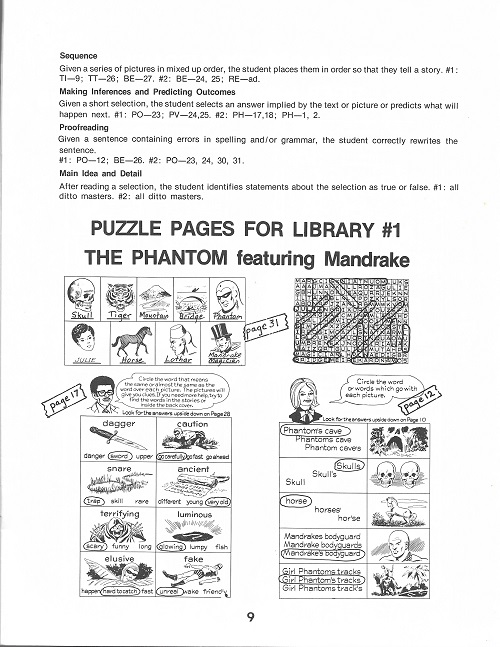
The ‘Teacher’s Guide – King Comics Reading’ manual provides teachers with ‘cheat notes’ on how the activities are to be completed, plus the educational purpose behind them to optimize and enhance the utilization of comics as a teaching tool in the classroom. The 2 pages found in the manual which correspond with the puzzles and quizzes found in the comic books can be seen below.

The Phantom comic books which featured in the program can be seen below, published in edition number 6 (The Phantom/Girl Phantom) and edition number 15 (The Phantom).

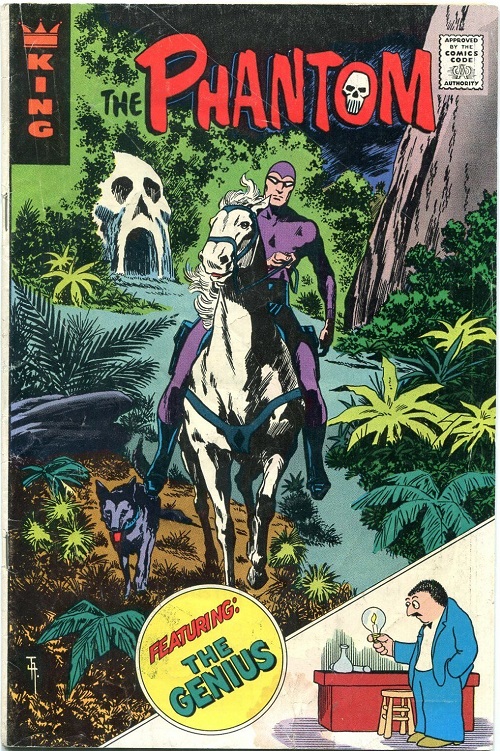
Incorporated within each issue of the 16 comic books were engaging educational puzzles and quizzes and a pictorial dictionary that centered on the story inside as well as the diverse cast of King Features characters showcased within that specific issue. The inside back cover of each edition contains the answers to these puzzles and quizzes.
Further information on The King Comics Reading Library Supplementary Reading Program can be found HERE
 thephantom.fan