
The Danish comic book series Fantomet, dedicated to the Phantom, has a rich publication history marked by its inception, evolution, and the contributions of various artists and writers.
In 1971, Interpresse launched Fantomet as a monthly comic book in Denmark, adapting content from Sweden’s Fantomen series. This schedule continued until 1978, when the magazine switched to a fortnightly publication. However, in 1984, it reverted to a monthly release until its final issue under Interpresse in 1994, culminating in a total of 358 issues.
The front and back covers of the first edition to be released by Interpresse in 1971 can be seen below, containing 52 black and white pages measuring 17cm x 26cm printed with Danish text.


After a brief hiatus, Egmont reintroduced the magazine in 1998, continuing the numbering from Interpresse’s run. This revival was short-lived, producing only 11 issues and bringing the series to a close with issue number 369, which can be seen below.

Interpresse was a Danish publishing company that played a significant role in the country’s comic book industry from the 1950s to the 1990s. Founded in 1954, Interpresse became one of Denmark’s leading publishers of comics, specializing in translations of popular European and American series. The company was instrumental in bringing international titles to Danish readers, publishing well-known comics such as Fantomet (the Phantom), Spider-Man, Batman, Tintin and Asterix.
During its peak years, Interpresse was known for maintaining high-quality print editions and fostering a strong comic book culture in Denmark. The publisher acquired the rights to Fantomet in 1971 and continued publishing it until 1994, producing 358 issues of the series. In the 1990s, as the comic book market changed and faced economic challenges, Interpresse was eventually absorbed by Egmont, which took over several of its titles. Despite its closure, Interpresse remains a significant name in Danish comic history, having introduced and sustained many beloved franchises for decades.
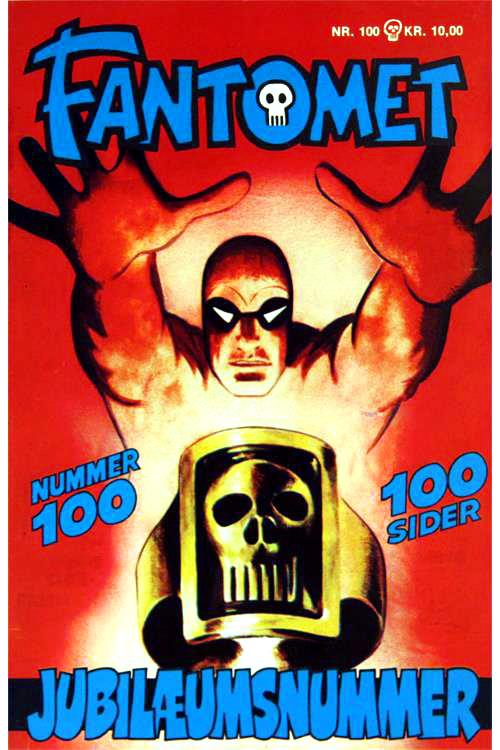
Throughout the Fantomet run under Interpresse, several issues stood out due to their unique content, special features, or rare collectability. One of the most notable was issue number 100, released in 1981 (seen on the left), which celebrated the milestone with a larger page count of 100 and included a retrospective on the Phantom’s history in Denmark, with cover art by Jaime Vallvé. Another significant issue was edition number 200, published in 1982 containing 100 pages, which similarly marked its anniversary with bonus content, including interviews with artists and writers who had worked on the series.
Additionally, Fantomet special issues occasionally included unique cover art or storylines exclusive to the Danish market. Certain anniversary editions included additional content or feature articles or key Phantom story sagas. These special releases contributed to the legacy of Fantomet in Denmark, giving collectors and fans memorable editions beyond the standard run of the series.
The Fantomet series benefited from the talents of numerous artists and writers, collectively known as ‘Team Fantomen’. This group included notable figures such as Dick Giordano, Donne Avenell, Heiner Bade, David Bishop, Dai Darell, Georges Bess, Jaime Vallvé, Joan Boix, Tony DePaul, Ulf Granberg, Ben Raab, Rolf Gohs, Scott Goodall, Eirik Ildahl, Kari Leppänen, Hans Lindahl, Janne Lundström, Cesar Spadari, Bob McLeod, Jean-Yves Mitton, Lennart Moberg, Claes Reimerthi, Paul Ryan, Alex Saviuk, Graham Nolan, Romano Felmang, and Norman Worker. Their collective efforts significantly shaped Phantom storylines adding to his mythos and greatly improving upon artistic direction of the series.
The Danish Fantomet comic book series stands as a testament to the enduring appeal of the Phantom character. From its initial publication in 1971 by Interpresse to its brief revival by Egmont in 1998, the series offered readers a consistent and engaging portrayal of the masked hero. Special editions, such as those produced by E-voke in 2024, further highlight the character’s lasting impact and the dedication of publishers to keep the legacy alive. The contributions of Team Fantomen were instrumental in crafting stories that resonated with audiences, ensuring that the Phantom remained a beloved figure in Danish comic history.
 thephantom.fan