
The Phantom Serial daybill poster was produced by W.E. Smith Ltd in Australia in the 1940s. The poster was produced featuring the Columbia Pictures production of the Phantom Serial released in USA in 1943, staring Tom Tyler playing the part of the Phantom and Jeanne Bates playing the part of Diana Palmer.
Theatre daybill posters, a captivating form of Australian theatrical history, are a distinctive type of advertising that emerged in the early 20th century. These posters, typically measuring around 15×40 inches, were designed to be displayed on a daily basis outside theatres to promote the current production. Their name “daybill” is a direct reference to their daily use and short-term display, often featuring a hand-stamped or written date and a “Today” banner to emphasize the immediacy of the performance. Unlike the larger, more ornate posters designed for long-term display, daybills were smaller, more practical, and often printed on thinner paper, making them a cost-effective and efficient way for theatre managers to advertise their daily shows.
What makes daybill posters particularly intriguing is their unique aesthetic and their reflection of the era’s design sensibilities. They often featured bold, dynamic typography, vibrant colors, and sometimes striking illustrations that captured the essence of the play or film being shown. The style was heavily influenced by art deco and art nouveau, with a focus on clean lines, geometric shapes, and a sense of dramatic flair. Daybills for popular genres like film noir or musicals would often have a very different visual language, reflecting the tone and content of the production. Beyond their aesthetic appeal, daybills also serve as valuable historical documents, providing a snapshot of the entertainment landscape of a bygone era, from the types of plays and films that were popular to the specific dates and venues where they were performed.
Today, these vintage daybill posters are highly sought after by collectors and enthusiasts of both theatre history and graphic design. Their rarity, coupled with their unique visual charm, makes them prized artifacts. Many have been preserved due to their sturdy construction and the sheer volume produced during their heyday. They offer a tangible connection to the past, allowing us to see how live performances and films were promoted to the public. As a result, daybills are not just pieces of paper; they are a window into the cultural and social history of Australia, telling a story of a time when the daily changing poster was the primary source of information for a night at the theatre or cinema.
Daybill posters represent a specific format and size of movie posters traditionally exhibited in theaters. Over the years, the dimensions of Daybill posters have evolved.
- Pre-War – 15” x 40”
- War-Time – 10” x 30”
- Post-War – 13” x 30”
- Post-1980s – 13” x 26”
The Phantom Serial daybill poster is produced in vibrant full color, with dimensions of 13 inches by 30 inches. An illustrative example may be found below.
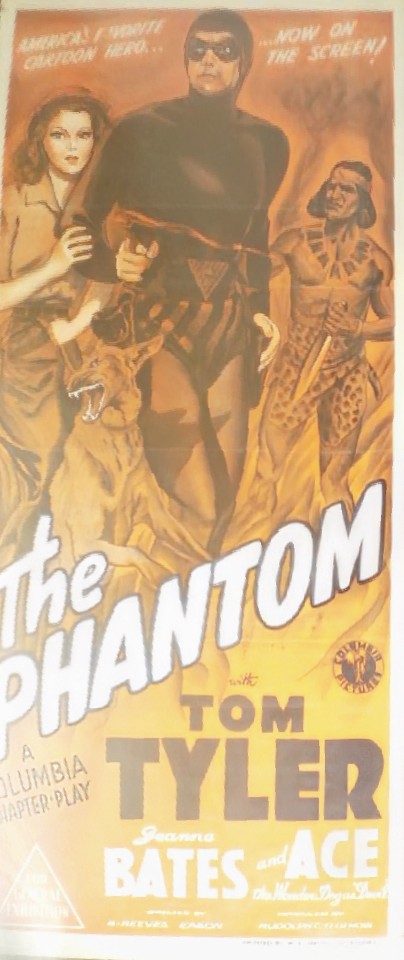
The daybill poster features printing on one side, with the printer’s name, ‘W.E. Smith Ltd’, located at the bottom right. Additionally, the ‘Columbia Pictures’ logo, the producer of the serial, is prominently displayed on the poster in black print. A viewer rating of the movie is also indicated in the lower left corner, enclosed within a white printed triangle that reads ‘For General Exhibition’.
 thephantom.fan