
The Phantom Serial Posters were produced by Morgan Lithograph Corporation in Cleveland, Ohio, USA in 1943. They were commissioned as a promotional item for the 1943 released Phantom Serial by the production company Columbia Pictures, under license of King Features Syndicate.
The WJ Morgan Lithographers was established by brothers William Morgan and George Morgan in Cleveland, Ohio, USA in 1864. The printing company originally produced advertising collateral for local businesses, including broadsheets, trade cards, pamphlets, blotters, postcards and posters. Due to the quality of their work, the company quickly grew, with orders flowing in from interstate organizations.
The Company adopted the stone lithographic process to create its advertising materials. They produced art in-house by employing a team of artists to illustrate and design high quality advertisements printed across a variety of products. These artists commonly travelled to their clients’ locations who were able to illustrate buildings, factories, shop facades or merchandise which often appeared on their advertising materials.
In 1887, WJ Morgan Lithographers was renamed to Morgan Lithographic Company and focused on the entertainment industry, designing posters, broadsheets, lobby cards and other collateral for production companies, theaters and traveling companies.
One of their clients was the Ringling Brothers Circus. From its work with this Circus, the Morgan Lithographic Company lays claim to being the first Company to create billboard-size posters or ‘twenty-four sheet billboards’. These were approximately 269cm x 594cm in size in landscape format, printed in approximately 12 overlapping sections, issued folded. They were produced to advertise on a roadside billboard.
The quality of the Morgan Lithographic Company’s work continued to grow, gaining more and more attention and even winning awards at the Paris World Fair and Chicago Exposition in the 1890s. They were the printing Company of choice by film production companies, becoming a leader in film advertisement.
As the company grew both in volume of work and financial success, it stared to increase its market share by purchasing smaller printing houses, resulting in an expansion of production facilities.
In 1913, the Morgan Lithographic Company produced oversized three-sheet and six-sheet posters as well as standard one-sheet posters measuring 27” wide by 41” high, setting the industry standards at the time.
The Morgan Lithograph Company is still in operation, a printing house to this day trading under the name of Morgan Litho.
The Phantom Serial Posters were printed in full color measuring 27” x 41” with a total of 15 posters produced, 1 for each Serial Chapter. A constant illustration of the Phantom, Diana and Devil is seen on all 15 posters, with an internal Serial still image, Chapter title and Chapter number changing on each poster, alternating in color between green and blue.
12 of the 15 Phantom Serial Posters can be seen below.


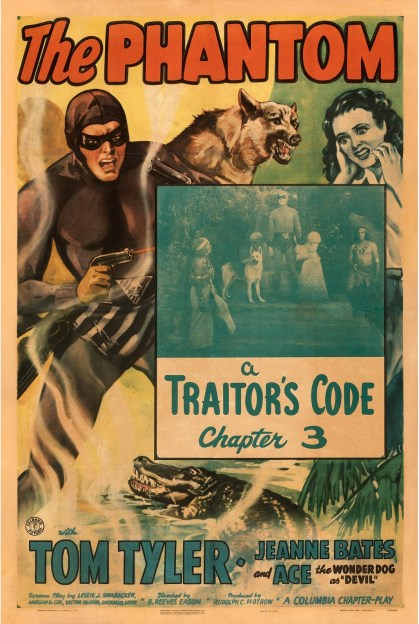
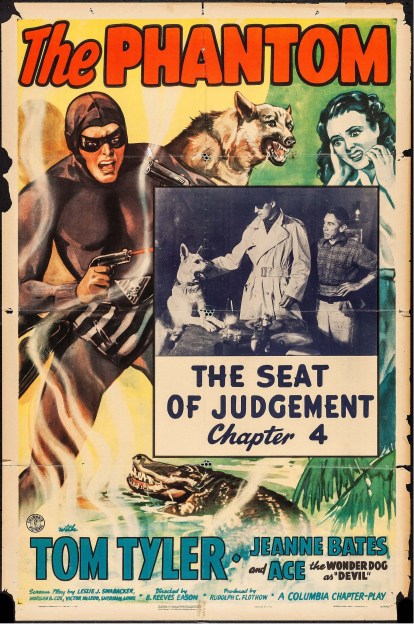


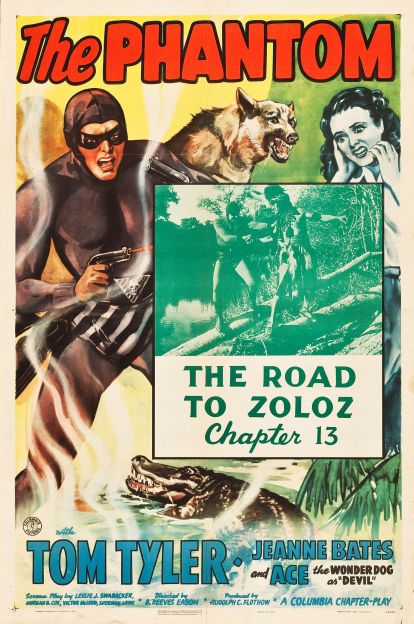


The 15 Chapter titles are:
- Chapter 1 – The Sign of the Skull
- Chapter 2 – The Man Who Never Dies
- Chapter 3 – A Traitor’s Code
- Chapter 4 – The Seat of Judgment
- Chapter 5 – The Ghost Who Walks
- Chapter 6 – Jungle Whispers
- Chapter 7 – The Mystery Well
- Chapter 8 – In Quest of the Keys
- Chapter 9 – The Fire Princess
- Chapter 10 – The Chamber of Death
- Chapter 11 – The Emerald Key
- Chapter 12 – The Fangs of the Beast
- Chapter 13 – The Road to Zoloz
- Chapter 14 – The Lost City
- Chapter 15 – Peace in the Jungle
The posters were displayed at theaters featuring the Phantom Serial, with a new poster displayed as the 15 Chapters were aired, commencing on the 24th of December, 1943. The posters were ordered by the theater’s for .15cents from Columbia Pictures with the theater displaying the posters on presentation boards with pins on each corner. The posters were mailed by Columbia Pictures to theaters folded in an envelope.
 thephantom.fan