
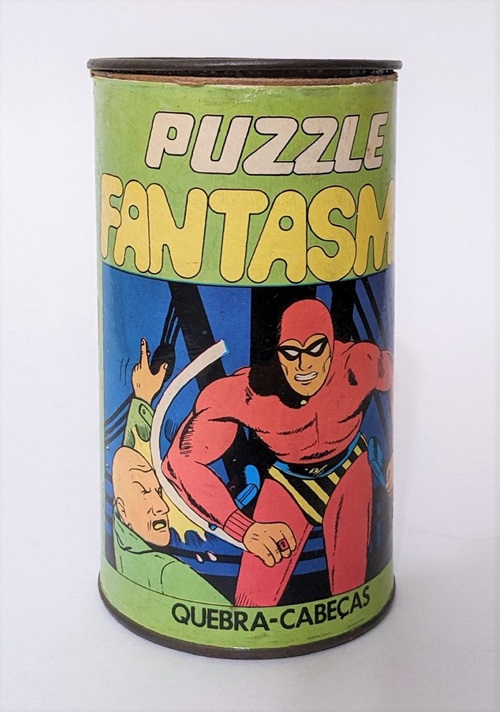
The Fantasma Canister Jigsaw Puzzle was produced by Necape Co. in Brazil in 1978.
The Necape Co. toy company is headquartered in São Caetano do Sul, situated within the metropolitan region of São Paulo, Brazil. The company played a significant role in the toy industry in Brazil.
The Origin of Jigsaw Puzzles
Jigsaw puzzles, in their essence, involve the intricate assembly of a picture by interlocking uniquely shaped pieces. It’s worth noting that in Portuguese, the term ‘Quebra-Cabecas’ translates to ‘jigsaw-puzzle’ in English, emphasizing the nature of these puzzles as being composed of various differently-shaped pieces that ultimately fit together to create a coherent image.
Historically, cardboard jigsaw puzzles made their appearance in the late 1800s. However, their adoption was gradual, as manufacturers hesitated to replace wooden puzzles. This hesitation stemmed from concerns that cardboard puzzles might be perceived as lower in quality, and wooden puzzles offered more substantial profit margins.
The Collectible Tin Canisters of the 1960s and 1970s
During the 1960s and 1970s, metal tin canisters gained popularity as a housing for jigsaw puzzles. These canisters not only served a functional purpose but also added a touch of nostalgia to the puzzle experience. Today, they have become highly sought-after collectibles, reflecting the enduring appeal of these puzzles and their historical packaging.
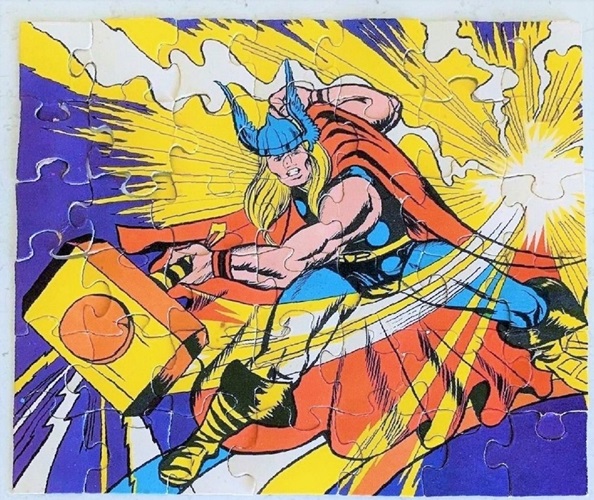
In 1978, Necape Co. introduced a series of four unique cylinder-shaped tin-can-packaged superhero jigsaw puzzles, each measuring 6″ x 3.5″. The body of the canister is made of thick cardboard with a wrap-around color label, with the lift-off lid and base made of metal. The lineup featured iconic characters such as the Phantom, Thor, The Hulk and Spiderman. The Fantasma Canister Jigsaw Puzzle can be seen below.


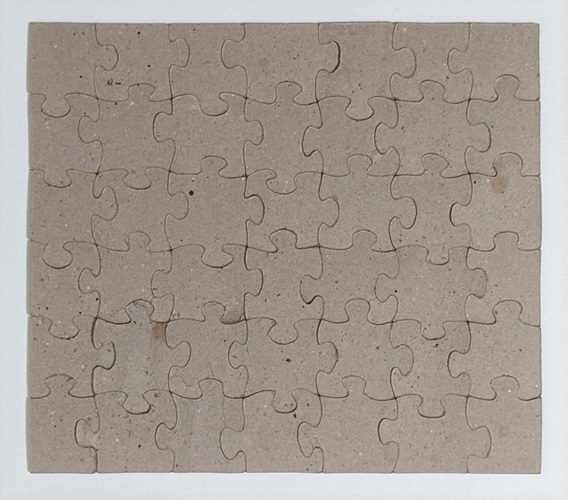
The 42 piece Fantasma jigsaw puzzle found within the canister can be seen below, with the Phantom seen in his red costume as he’s published in Brazil.

While the Fantasma Canister Jigsaw Puzzle lacks a specific date stamp, we can reasonably deduce that it was manufactured during the same year as the other superhero-themed canned puzzles. A clear indicator is found on the Thor puzzle, which bears the unmistakable imprint of 1978, providing insight into the production timeline of the jigsaw puzzles.

The tin cans production reference number is REF. 10.184, which unfortunately lacks any available information. However, the side of the canister provides more distinctive references, including copyright notices attributed to King Features/APLA. Additionally, it features the following identifiers: ‘JOGOS Brinquedos NIG’.
The various information references seen on the canister include:
- JOGOS translates to ‘Games’.
- Brinquedos equates to ‘Toys’.
- NIG can be loosely interpreted as ‘Pieces’.
Furthermore, the manufacturer of this puzzle is identified as ‘NECAPE – Industria E Comercio LTDA’. The company’s address is listed as CAIXA Postal 360 – SAO CAETANO DO SUL, with the associated C.G.C. (Cadastro Geral de Contribuintes) number: 59.274.589/0001-69. Notably, the label ‘Industria Brasileira’ underscores the product’s Brazilian origin.
The illustration artist associated with this tin can is believed to be Walmir Amaral. Remarkably, Walmir commenced his professional career at the early age of 17, finding his artistic footing at RGE – Rio Gráfica Editora. Here, he was primarily recognized for his compelling illustrations gracing Fantasma comic book covers.
Walmir’s artistic contributions extended beyond the Phantom, notably encompassing his noteworthy work on O Cavaleiro Negro, the Brazilian counterpart of the American Black Rider. Furthermore, he made his mark by lending his artistic talents to the series Zorro, published by Abril during the 1970s.
While it is highly likely that Walmir Amaral is the creative mind behind the puzzle artwork, it’s important to note that this attribution is not definitively confirmed.
This jigsaw puzzle represents a venerable piece of Phantom memorabilia, making it one of the earliest licensed Phantom jigsaw puzzles to grace the collector’s world. Its rarity is truly exceptional, positioning it as a coveted treasure among Brazilian Phantom enthusiasts and collectors.
Thank you Christopher Smith for assisting with images and information.
 thephantom.fan