
SMASH! L’epoca D’oro Dei Fumetti (which translates to “SMASH! The Golden Age of Comics”) is a book published by Arnoldo Mondadori Editore in Milan, Italy in July 1975. The hardcover reference book is written by Benito Palmiro Boschesi and contains illustrations by Roberto Cattelan and layouts by Agostino Carabelli. An imprint at the commencement of the book notes “Edizione fuori commercio” (Not for retail sale). This volume was produced exclusively as a promotional gift or premium item sent out to subscribers of various Mondadori periodicals and magazines during the mid-1970s.
Arnoldo Mondadori Editore was founded in Italy in 1907 by a young printer named Arnoldo Mondadori in the small village of Ostiglia, the company began as a humble editorial effort fueled by a passion for journalism. Early success arrived through educational series like La Lampada, designed to promote literacy among youth in rural Italy. By the 1920s, Mondadori relocated its headquarters to Milan and began to reshape the Italian literary landscape with defining innovations, such as introducing the giallo (detective thriller genre) and specialized series like Medusa that introduced contemporary foreign literature to Italian readers. A landmark agreement signed in 1935 to publish Walt Disney’s work including the iconic Topolino comic magazine, solidified the company’s reputation for visionary licensing and mainstream appeal.
World War II temporarily halted this trajectory when the publisher’s Verona printing facilities were confiscated and its Milan offices suffered severe bomb damage. While in exile in Switzerland, Arnoldo and his son Alberto utilized their international connections to acquire post-war translation rights for major American authors like Ernest Hemingway and William Faulkner. Bolstered by Marshall Plan funding, Mondadori rebuilt a massively expanded, state-of-the-art plant in Verona, pushing heavily into illustrated weekly news magazines like Epoca and Panorama. In 1965, the company permanently democratized reading in Italy by introducing the Oscar Mondadori series, which brought classic and modern literature to the general public in affordable, low-cost paperbacks sold at newsstands.
Today, the Mondadori Group stands as Italy’s largest and most dominant publishing house, maintaining a massive market share across trade books and school textbooks. Headquartered in a landmark building designed by Oscar Niemeyer in Segrate, near Milan, the company went public on the Milan Stock Exchange in 1982. Over the decades, it has expanded through major corporate shifts, including eras under the ownership of the Berlusconi family and strategic acquisitions of rival general publishers like Rizzoli and comic publishers like Star Comics. Spanning over 25 distinct brands, a vast digital footprint, and a retail network of over 500 brick-and-mortar bookstores across Italy, Mondadori continues to dictate the country’s cultural, literary, and mass media landscape.
SMASH! L’epoca D’oro Dei Fumetti is a hardcover book containing 128 black and white pages measuring 21.5cm x 30.5cm printed with Italian text. The front and back covers are illustrated by Davide Danti, featuring a mix of comic book characters including Mandrake the Magician, Mickey Mouse, Krazy Kat, Popeye, Dick Tracy and Flash Gordon. The front and back covers can be seen below.
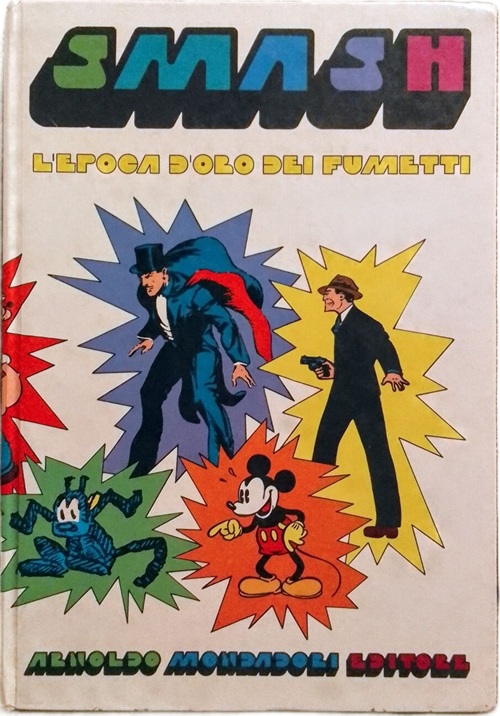
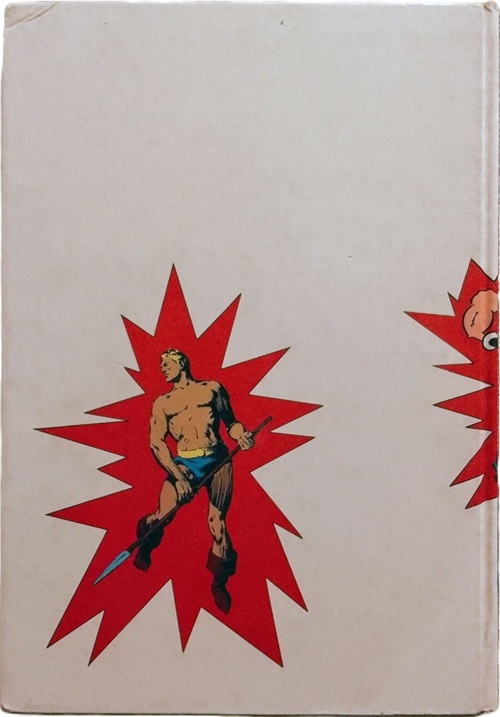
The book serves as a historical and retrospective anthology celebrating the greatest hits of classic European and American comic strips from their late 19th-century origins up through the mid-20th century. The sections detailed in the index include:
- The Pioneers: Max e Moritz, Yellow Kid, Buster Brown, and The Katzenjammer Kids (I monelli Katzenjammer / Bibì e Bibò).
- Early Masters: Little Nemo and Krazy Kat.
- Classic Strips & Comedy: Bringing Up Father (Arcibaldo e Petronilla), Blondie, Popeye (Braccio di Ferro), Felix the Cat, Li’l Abner, and Little Orphan Annie.
- Adventure & Pulp: Tarzan, Buck Rogers, Dick Tracy, Brick Bradford, Flash Gordon, Jungle Jim, Secret Agent X-9, Red Barry, Radio Pattuglia, Mandrake, Terry and the Pirates, The Phantom (L’uomo Mascherato), and Prince Valiant.
- Disney & Superheroes: Gli eroi di Walt Disney (Mickey Mouse & friends), followed by the definitive comic book titans Superman and Batman.
- Regional Spotlight: A dedicated section celebrating early domestic Italian comic strip legends (Gli eroi italiani).
Comprehensive information regarding the Phantoms publication in Italy, along with the diverse illustrators who have contributed to the Phantom series, is meticulously outlined in the book, commencing on page 105 and continuing through to page 109. A sample of these pages can be seen below.

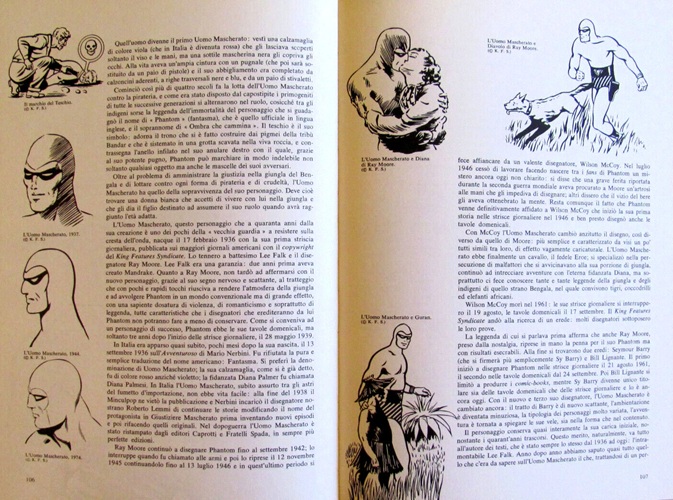
Based on the text in the provided images, the entry for L’Uomo Mascherato (The Phantom) opens by detailing the legendary origins of the character. The narrative traces back to the year 1530, when a cargo ship was attacked in the Gulf of Bengala by the Singh pirates. The lone survivor, a young sailor named Walker whose father was killed in the assault, was washed ashore on the beaches of Bengala. Rescued and cared for by the native Bandar pygmies, Walker discovered his father’s body washed ashore days later. Standing before a grand fire with his father’s skull, he swore a solemn oath to dedicate his life to the destruction of piracy and cruelty, a vow that would be passed down to his descendants. The text notes that while the character’s official name is the Phantom, he is also known by his legendary moniker, “The Ghost Who Walks” (L’Ombra che cammina), operating from the Skull Cave and using his ring to leave an indelible mark on wrongdoers.
The text also provides a comprehensive editorial and publishing history of the character, noting his debut on the 17th of February 1936, through the King Features Syndicate, created by Lee Falk and illustrated by Ray Moore. It highlights the international adaptation quirks, explicitly mentioning that while the character wears a purple costume in the original strips, it famously became red (rossa) in Italy, where he was named L’Uomo Mascherato rather than a literal translation of “Fantasima”. The history follows the lineage of the strip’s classic artists, charting the transition from Ray Moore’s moody style to Wilson McCoy who took over official duties in 1946 after Moore left during WWII and eventually to Sy Barry in 1961 following McCoy’s passing. The text notes that under Barry, the art style evolved to become more modern and detailed, helping the character sustain his immense global popularity for over forty years up to the book’s publication.
 thephantom.fan