
New Left Comics is a book published by Routledge in Sweden in March 2026. Written by Robert Aman, the book examines how Swedish comic creators used mainstream comics (such as the Phantom) in the 1970s to discuss New Left ideology, social justice, and international politics. The book is of interest to researchers and students in comics studies, cultural studies, media studies, and sociology.
Robert Aman is Associate Professor in Education. He received his Ph.D. from Linköping University (2014) and has been a Senior Lecturer in Education at the University of Glasgow (2015-2017), and a visiting research fellow at Duke University (2010), University of Oxford (2013), and Sciences Po Paris (2015).
His publications include the books Impossible Interculturality?: Education and the Colonial Difference in a Multicultural World (Linköping, Linköping University Press, 2014), Decolonising Intercultural Education: Colonial Difference, the Geopolitics of Knowledge, and Inter-Epistemic Dialogue (London, Routledge, 2017), and, with Timothy Ireland, Educational Alternatives in Latin America: New Modes of Counter-Hegemonic Learning (New York, Palgrave Macmillan, 2019).
Aman’s research is multidisciplinary with a base in critical cultural theory. He has published several articles on interculturality and intercultural education, indigenous movements in Latin America, multiculturalism, epistemic racism, and migration. His most recent work explores ideology in Swedish comic books with a particular focus on how the political ideals of the New Left during the 1970s found its way into superhero comics.
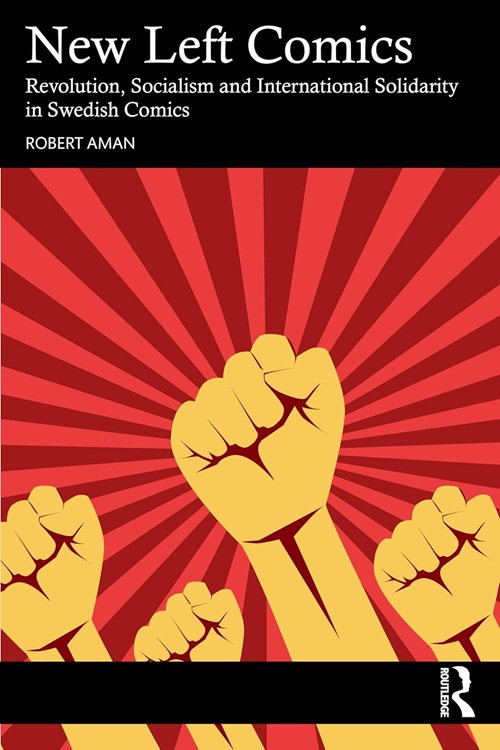
New Left Comics contains 168 black and white pages containing English text, available in both Paperback and Hardback formats. The front cover seen below features an image of several raised fists, a common symbol of protest, freedom, revolution, and solidarity.
The various chapters found in the book are:
- 1. Introduction
- 2. The Phantom and Foreign Aid
- 3. Johan Vilde and Colourblind Anti-racism
- 4. Tumac and the Revolution
- 5. Mystiska 2:an and the Underside of the Welfare state
- 6. Conclusion
The description provided by Routledge for the book reads:
Why does Johan Vilde testify about Sweden’s involvement in the transatlantic slave trade? Why do the young Stockholm sons, Stefan and Sacho, in Mystiska 2:an discuss class society and commercialism on their way back home from school? And why does the Phantom start a co-operative society in the jungle and act as a mouthpiece for Prime Minister Olof Palme? And in reverse: why is it almost impossible to imagine Spider-Man, Tintin, or Archie ruminating about trade union issues, gender equality on the labor market, or to take a stand against the apartheid regimes in Southern Africa?
New Left Comics examines the leftist radicalization in Sweden during the decade immediately succeeding 1968 through the lens of comic books. It looks at four of the most popular and widely read comic books and graphic novels – Johan Vilde, Tumac, Mystiska 2:an, and The Phantom – between 1968-1980, and uncovers the ways in which writers and artists used mainstream comics as a medium to teach and inform readers about various forms of injustices and inequality – as well as utopian futures – by adding social, political, and economic comments.
 thephantom.fan