
La Historieta Mundial (which translates to The World Comic Strip) is a book published by the Pan-American School of Art in collaboration with the Torcuato Di Tella Institute in Buenos Aires, Argentina in 1968. The reference book is written by Luis Gasca, David Lipszyc, Claude Moliterni, Oscar Masotta, Hideso Kondo, Piero Zanotto and Jorge Romero Brest and catalogues the First World Comics Biennial, held in Buenos Aires, Argentina.
The Pan-American School of Art, known for its contributions to art education in Latin America, partnered with the Torcuato Di Tella Institute, a prominent center for avant-garde art and culture in Buenos Aires during the 1960s. This collaboration aimed to highlight the significance of comics as a legitimate artistic and cultural expression.
La Historieta Mundial coincided with the Bienal Mundial de la Historieta (World Comic Biennial) held in Buenos Aires in 1968, an event that celebrated the art of comics and brought together artists, writers, and enthusiasts from around the world. La Historieta Mundial served as an important reference for attendees and contributed to the recognition of comics as a serious art form.
The book provides a comprehensive overview of the global history of comics, exploring the evolution of this art form across different cultures and time periods. It contains informative articles as well as illustrations that meticulously detail information regarding various comic book characters.
La Historieta Mundial was produced in paperback format which contains 98 black and white pages measuring 25cm x 32cm. The book focused on popular comic book characters from the eight participating countries who were represented at the Bienal Mundial de la Historieta event: Argentina, Spain, France, Brazil, Japan, United States, United Kingdom and Italy. The front and back covers can be seen below.
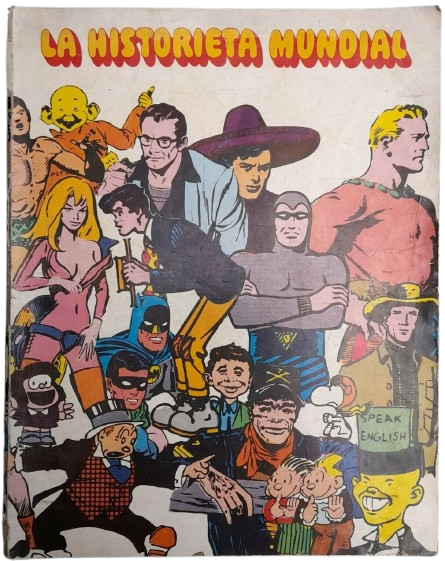
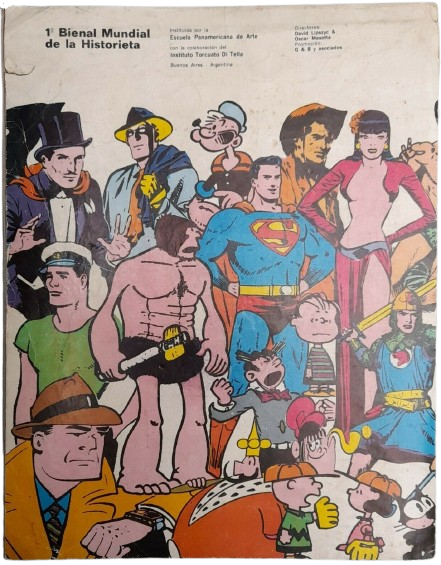
The colorful wraparound front cover is illustrated by Alberto Couste and contains a mix of comic book characters including the Phantom, Mandrake the Magician, Superman, Batman, Popeye, Dick Tracey, Prince Valiance, Modesty Blaise, Tarzan, Felix the Cat, The Little King and many more.
A Prologue is located at the beginning of the book, offering insights into its content written by Jorge Romero Brest, the Director of the Visual Arts Center at the Torcuato Di Tella Institute. In English, the Prologue states:
We would not complete the panorama of creation in the present, as we have proposed since the first day of our existence, if we did not address the question raised by comics. Because they are one of the mass media, of course, but more so because of the possibilities they present for studying the characteristics of the current consumer society, in relation to other social and cultural facts.
That is why we warmly welcomed the idea proposed by David Lipszyc, director of the Pan-American School of Art, and by Oscar Masotta, whose competence in this field of anthropology and sociology is well known; that of jointly holding the “First World Comics Biennial”.
The efforts of all will ensure that this event has the widest possible impact. The public will discover with amazement that comics have a history and a range of existence perhaps never even imagined, increasing their interest in them and, of course, their ability to enjoy them. And specialists in various sociological disciplines will have the opportunity to make inquiries that will be useful to everyone.
Finally, I feel I must point out as a symptom of the times the fact that such a manifestation takes place in the halls of an institution dedicated to the arts. It is not the first time that it has happened, but this time seems to me more definite than any other, revealing how sensitive we are to what is happening in the world, without worrying about maintaining the old structures, and without destroying them simply by the push of iconoclasts.
 thephantom.fan