
Norman Worker (1927 – 5th February 2005) was a prolific British writer whose career spanned decades, touching upon several genres, but who is perhaps best known and most fondly remembered for his significant and sustained contribution to the world of comic books, particularly for his extensive work on the Swedish-published the Phantom (Fantomen) comic strip adaptation.
Worker possessed a deep understanding of adventure, folklore, and character, allowing him to craft stories that were both action-packed and emotionally resonant. His output was vast, yet it was his dedication to Lee Falk’s jungle hero that cemented his legacy as one of the character’s most important non-American contributors.
Worker began his career in the 1950s, working in various capacities for British publications. He developed a reputation for his versatility, tackling everything from factual articles to adventure and horror fiction. His early comics work included contributions to titles like Lion and Valiant. He had a knack for creating compelling stories within the strict constraints of the comic book format, mastering the rhythm of dialogue and panel-to-panel progression. This groundwork laid the foundation for his later, more internationally recognized work. By the 1970s, Worker began to focus heavily on the international market, finding a particularly receptive audience in Scandinavia, where traditional adventure comics maintained a strong readership.
Norman Worker’s collaboration with the Swedish publisher Semic Press (later Egmont) on the Phantom (Fantomen) began in the 1970s and continued robustly into the 1990s. This relationship was pivotal, as the character, created by Lee Falk, was enjoying immense popularity in Scandinavia, leading to the creation of original stories to supplement the American syndicated newspaper strip. He used the name “John Bull” for some of his earlier work on the Phantom.
Worker became one of the key writers crafting these supplementary tales, working alongside artists like Hans Lindahl, Özcan Eralp, and Jaime Vallvé. Worker was instrumental in defining the tone and scope of these “Team Fantomen” stories, which often featured more complex plots, explored international settings, and allowed for deeper dives into the Phantom’s history and supporting cast than the original newspaper strips often permitted.
A defining feature of Worker’s tenure on the Phantom was his mastery of multi-part adventure serials that expanded the geography and mythology of the jungle hero. He was not content to keep the 21st Phantom solely in his traditional setting of Bengali; instead, Worker frequently sent the Ghost Who Walks on globe-trotting missions, from the frigid cold of the Arctic to the bustling cities of Europe, often pitting him against international criminal organizations, complex espionage plots, and shadowy figures from history.
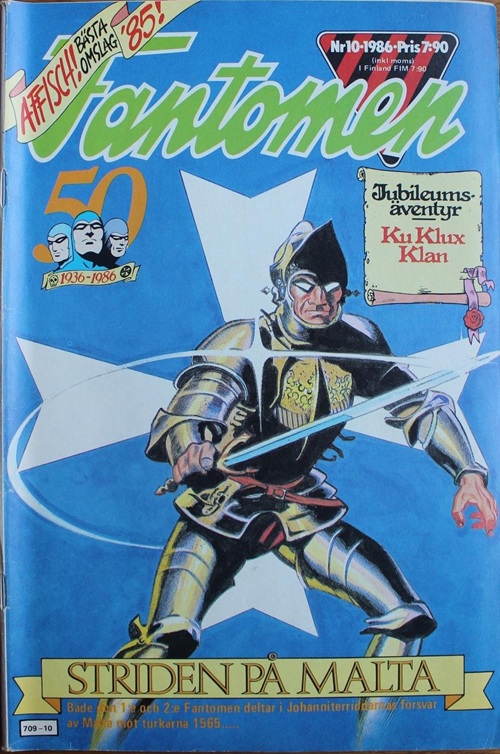
These expansive stories helped broaden the Phantom’s appeal and kept the series feeling fresh and modern for new generations of readers. His stories frequently featured a strong sense of realism and meticulous research regarding the non-Bengali locations, lending credibility to the extraordinary adventures. Such stories include The Battle on Malta, The Gold of the Incas, Flame, The Treasure from Rhodes, The Last Emperor and The Ibis Mystery.
Furthermore, Worker made significant contributions to the Phantom’s extensive supporting cast and lore. While respecting the canon established by Lee Falk, Worker often utilized characters like the Phantom’s wife, Diana Palmer-Walker, and their children, Kit and Heloise, in more active and central roles, enriching their personalities and relationships. His stories were known for their thematic depth, often touching upon environmentalism, the dangers of greed, and the cultural clash between the modern world and the tribal life of Bengali.
In one notable recurring theme, he frequently delved into the history of the Phantom lineage, writing compelling stories about the exploits of previous Phantoms. These historical tales provided depth and context to the current Phantom’s mission, showcasing how the tradition had adapted across centuries. He would go on to write 128 Phantom stories between 1976 thru till 2004, translated and published in numerous countries.
Beyond the Phantom, Norman Worker contributed to other comic series published by Semic/Egmont, including the European Mandrake the Magician stories. His work ethic was legendary, and he consistently delivered high-quality, engaging scripts over a period that spanned more than three decades. Worker’s writing style was marked by crisp dialogue, strong pacing, and a clear affection for the adventure genre.
Norman Worker passed away in 2005, leaving behind a monumental body of work that continues to be read and enjoyed by comic fans worldwide. For many non-American readers, especially those in the Nordic countries, the stories written by Worker are the definitive Phantom adventures. His dedication to maintaining the spirit of the character while simultaneously pushing the boundaries of the narrative cemented his place as a vital, international pillar in the enduring mythos of the Ghost Who Walks.
 thephantom.fan