
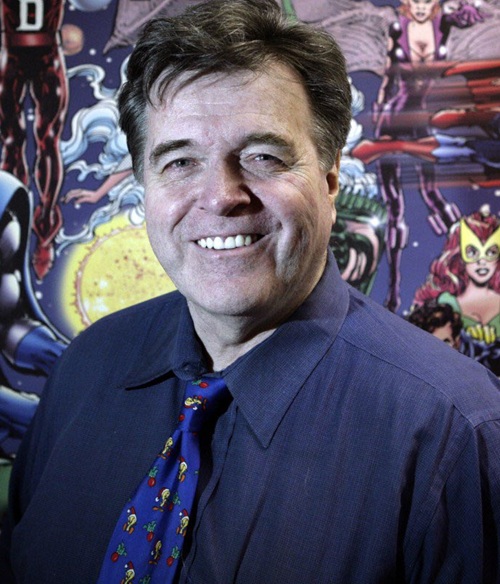
Neal Adams, born on the 15th of June 1941, on Governors Island, New York City, USA was a seminal figure in the comic book industry, renowned for his dynamic artistry and advocacy for creators’ rights. From an early age, Adams exhibited a profound interest in drawing, which he pursued through his education at the School of Industrial Art in Manhattan. Despite initial challenges breaking into the comic book industry, he began his professional career in the early 1960s, contributing to various publications.
Adams’s significant breakthrough occurred in the late 1960s when he started working with DC Comics. His realistic and expressive art style brought a fresh perspective to the industry. One of his notable early contributions was to “The Brave and the Bold,” where he illustrated Batman team-up stories. Adams’s depiction of Batman was instrumental in transitioning the character from the campy portrayal of the 1960s television series back to his darker, more brooding roots.
In collaboration with writer Dennis O’Neil, Adams worked on the “Batman” series, producing iconic storylines that delved into complex social issues and redefined the character for contemporary audiences. Their partnership extended to the “Green Lantern/Green Arrow” series, which began in 1970. This groundbreaking run addressed various societal issues, including racism, drug addiction, and environmental concerns, marking a significant evolution in comic book storytelling.
Beyond DC Comics, Adams contributed to Marvel Comics, where he worked on titles such as “X-Men” and “The Avengers.” His tenure on “X-Men” in the late 1960s, alongside writer Roy Thomas, is particularly celebrated for revitalizing the series with innovative layouts and a dynamic visual style. Adams’s influence extended to other characters, including the “Phantom Stranger,” where he provided compelling cover art that captured the mysterious essence of the series.
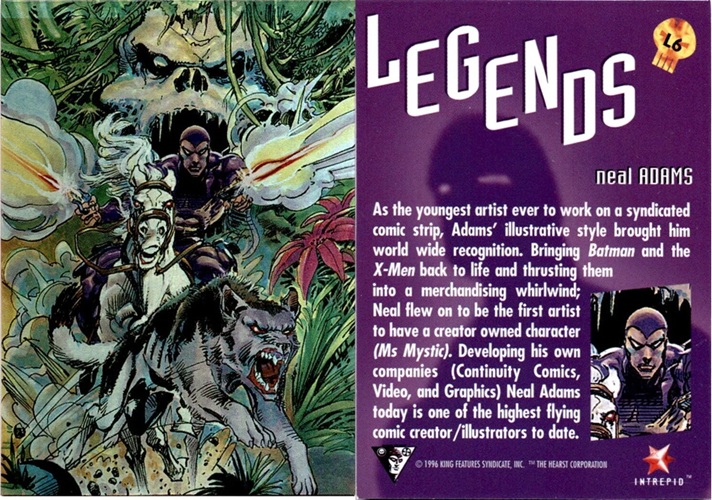
In 1996, Neal Adams was commissioned by Intrepid to produce a piece of art featuring the Phantom, which was incorporated into The Phantom Gallery trading card set released in Australia as part of the Legends special insert cards, numbered L6. This trading card, characterized by a highly reflective foil finish, is double-sided; the front displays the Phantom racing from the Skull Cave on Hero with Devil leading the charge, while the reverse contains a brief biography of Neil Adams. The front and back of the trading card can be seen below.
Neal Adams was a pivotal figure in championing creators’ rights within the comic book industry, advocating for fair treatment and recognition of artists and writers. In the 1970s, he actively sought to unionize comic book creators, aiming to establish a professional guild to protect their rights. This initiative led to the formation of the Comics Creators Guild in 1978, which included over three dozen writers and artists, such as Steve Ditko, Frank Miller, and Marv Wolfman.
Adams was instrumental in lobbying for the return of original artwork to creators, a practice not standard at the time. His efforts culminated in 1987 when Marvel Comics returned original art to him and industry legend Jack Kirby, setting a precedent that allowed artists to earn additional income from art sales to collectors.

Adams played a significant role in advocating for Superman creators Jerry Siegel and Joe Shuster. He led lobbying efforts that resulted in Siegel and Shuster receiving overdue credit and financial remuneration from DC Comics, acknowledging their contributions to the creation of Superman.
In the mid-1970s, as Warner Bros. prepared to produce a Superman film directed by Richard Donner, Jerry Siegel publicly condemned the project, highlighting his and Shuster’s financial hardships and the lack of acknowledgment from DC Comics. This outcry garnered the support of industry figures like Neal Adams and Jerry Robinson, who spearheaded a public relations campaign advocating for better treatment of comic creators.
Adams’s efforts were instrumental in bringing widespread attention to Siegel and Shuster’s plight. He leveraged media outlets to shed light on the creators’ financial struggles and the ethical implications of their situation. This mounting public pressure led Warner Bros. and DC Comics to negotiate a settlement in 1975, granting Siegel and Shuster a yearly stipend of $20,000 each, along with medical benefits. Additionally, DC Comics agreed to credit Siegel and Shuster as the creators of Superman in all future publications, films, and television productions.
This landmark agreement not only provided Siegel and Shuster with much-needed financial support and recognition but also set a precedent for the industry, highlighting the importance of acknowledging and compensating creators for their contributions. Neal Adams’s advocacy in this case was a significant milestone in the broader movement for creators’ rights within the comic book industry.
Throughout his career, Adams’s work garnered numerous accolades, reflecting his profound impact on the comic book medium. His realistic art style, combined with a commitment to storytelling that addressed real-world issues, set new standards for the industry. Neal Adams passed away on the 28th of April 2022, leaving behind a legacy that continues to influence artists and writers, embodying a commitment to artistic excellence and creators’ rights.
 thephantom.fan