
Ronald Keith Chatto, born on the 30th of November 1924, in Kogarah, New South Wales, Australia, emerged as a pivotal figure in the Australian comic art scene during the mid-20th century. His extensive body of work, spanning various genres and media, showcases his versatility and profound impact on Australian popular culture.
Chatto’s artistic inclinations were evident from a young age. He received his education at Kogarah Primary School, Canterbury High School, and Sydney Grammar School. During his adolescence, while recovering from an illness, he began to draw, nurturing a passion that would define his career. His father, an accountant for Smith’s Weekly, recognized his son’s talent and introduced his sketches to the magazine’s art staff. This connection led to Chatto attending weekly art classes under the guidance of Jim Russell, a notable Australian cartoonist.
With the onset of World War II, Chatto contributed to the war effort by drawing aircraft recognition charts for the Australian Air Training Corps. He later enlisted in the Royal Australian Air Force (RAAF), serving his country during a tumultuous period.
After his demobilization in 1946, Chatto ventured into the burgeoning Australian comic industry. His inaugural comic strip, ‘Destiny Scott’, debuted in the mid-week children’s section of the Sydney Morning Herald on 26th of June 1946. This marked the beginning of a prolific period where he created and contributed to numerous comic strips, including ‘Bunny Allen’, ‘The Glamour Girl’, and ‘The Buccaneer’ for All-Australian Comics.
In 1949, Chatto introduced ‘The Lone Wolf’ for Atlas Publications, a series that would later be illustrated by Yaroslav Horak. By 1954, he developed ‘Steven Carlisle’ for Larry Cleland Publishing Company, further cementing his reputation as a versatile comic artist.
The mid-1950s saw Chatto expanding his artistic endeavors into commercial art. He produced magazine illustrations, record sleeves, and pulp fiction novel covers, at times creating up to six covers a week. Notably, he worked on ‘The Twilight Ranger’ and ‘El Lobo’ for Cleveland Publishing, showcasing his ability to adapt to various genres and styles.
With the advent of television, Chatto transitioned into the film industry, becoming a freelance film producer and cine-cameraman. Despite this shift, he maintained a connection to the comic world, producing comic book covers for Page Publications and a series of ‘Skippy’ comics in 1967, based on the popular Australian television series.
Keith Chatto’s Work on The Phantom
Keith Chatto’s contributions to the Phantom are among the most celebrated aspects of his illustrious career. His work brought a unique Australian perspective to Lee Falk’s legendary comic series, making him a pivotal figure in the global Phantom community. Chatto’s involvement with the Phantom began in the 1990s and included some of the most iconic and original stories ever created for the series.
It started when Jim Shepherd, editor and publisher of Frew Publications, approached him to illustrate new stories for the Australian editions of the comic. Frew Publications, the Australian publisher of the Phantom, had long been producing and distributing reprints of Phantom stories originally created by Lee Falk and his artists. However, Shepherd’s decision to produce original, locally crafted stories allowed Chatto to bring his distinctive artistic style and storytelling prowess to the series.
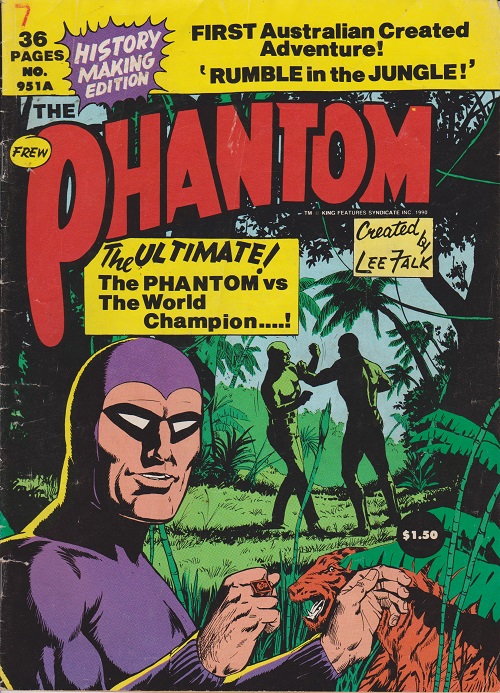


Keith Chatto illustrated 22 Phantom comic covers and 3 published Phantom comic strip stories (he was in the process of a 4th story) for Frew Publications. These 4 stories are:
- Rumble in the Jungle (1990): Chatto’s first major work on the Phantom was ‘Rumble in the Jungle’, an action-packed tale written by Jim Shepherd (as can be seen above). This story marked a significant milestone in Phantom history as it was the first full-length Phantom story written and drawn in Australia. Chatto’s dynamic art style, characterized by meticulous attention to detail and expressive character designs, elevated the story and set a high standard for subsequent Australian Phantom stories.
- Return of the Singh Brotherhood (1992): In this sequel to the very first Phantom story written by Lee Falk, Chatto reimagined the Phantom’s legendary adversaries, the Singh Brotherhood, in a modern and visually captivating way. His illustrations brought a fresh yet faithful interpretation of the Phantom’s early lore, bridging the gap between classic and contemporary storytelling.
- The Kings Cross Connection (1992): One of Chatto’s final works before his untimely death, ‘The Kings Cross Connection’, is a gripping tale that takes the Phantom to urban Australia. The story combines elements of traditional Phantom adventures with a distinctly Australian setting, showcasing Chatto’s ability to adapt the character to new and diverse environments. His artwork vividly depicted the gritty urban landscape, creating a striking contrast to the dense jungles typically associated with the Phantom.
- The Revenge of Kharmi (Unfinished): Chatto was working on ‘The Revenge of Kharmi’ at the time of his passing. This story was intended as a continuation of the Phantom’s earlier encounters with the character of Kharmi, a recurring and enigmatic antagonist in the series. Although the story remained incomplete, early drafts and sketches revealed Chatto’s plans to delve deeper into Kharmi’s motivations and her complex relationship with the Phantom. The unfinished nature of ‘The Revenge of Kharmi’ adds an air of mystery and poignancy to Chatto’s legacy, leaving fans to imagine what might have been a compelling and layered narrative.
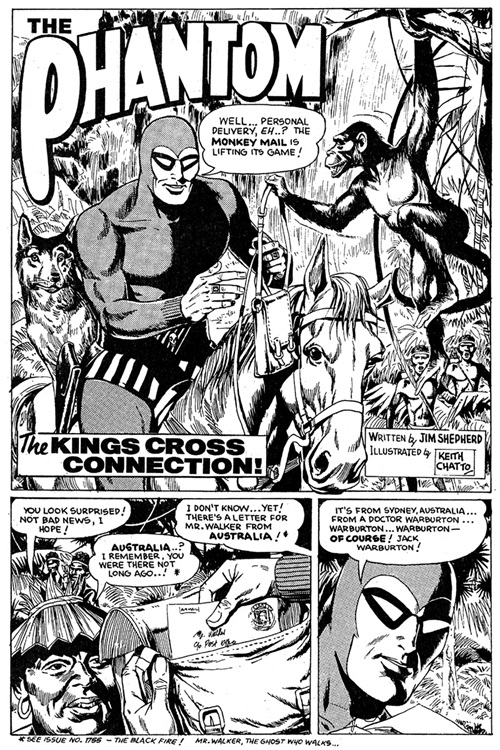
Chatto’s work on the Phantom is distinguished by his realistic and dynamic art style. He had an exceptional ability to render human anatomy, facial expressions, and intricate backgrounds, lending a cinematic quality to his illustrations. His attention to detail extended to the Phantom’s costume, making it appear both heroic and practical, while maintaining the mysterious aura that defines the character.
Moreover, Chatto’s use of shading and line work added depth and texture to his panels, enhancing the drama and tension of each scene. Whether depicting high-stakes action sequences or quiet moments of introspection, Chatto’s art brought a sense of authenticity and gravitas to the Phantom’s adventures.
Keith Chatto’s contributions to the Phantom remain highly regarded by fans and collectors. His stories, though relatively few in number, are celebrated for their originality, artistic excellence, and cultural significance. By introducing Australian elements into the Phantom’s world, Chatto expanded the character’s reach and enriched his legacy.

Beyond his direct contributions, Chatto’s work inspired a new generation of Australian comic artists and writers, demonstrating the potential for local talent to make a lasting impact on an internationally beloved franchise. His collaborations with Frew Publications also paved the way for other original Phantom stories, solidifying Australia’s unique role in the character’s history.
Keith Chatto passed away from cancer on the 22nd of October 1992 at the age of 67. His adaptability across various media and genres, coupled with his dedication to his craft, left an indelible mark on Australian popular culture. His contributions continue to be celebrated by enthusiasts and serve as an inspiration for future generations of artists.
 thephantom.fan