
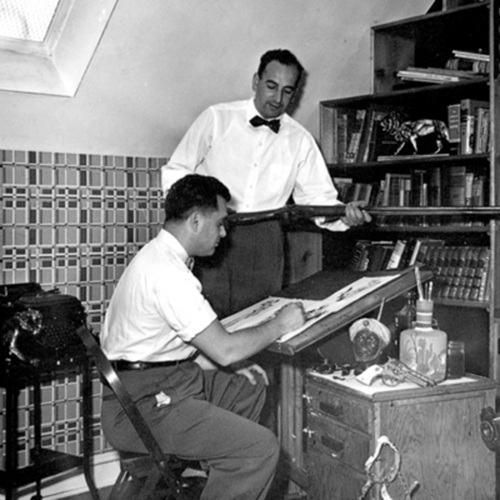
Joe Simon was a defining figure in the history of American comic books, a prolific artist, writer, editor, and publisher whose influence spanned decades. Born Hymie Simon on the 11th of October 1913, in Rochester, New York, USA, he was the son of Jewish immigrants from England. His early interest in art led him to pursue a career in illustration, first working as a newspaper artist and photo retoucher before transitioning into the burgeoning comic book industry in the late 1930s.
Simon’s first professional comic book work appeared in 1939 when he illustrated the Western-themed Fiery Mask for Timely Comics, the precursor to Marvel. It was around this time that he met Jack Kirby, a partnership that would become one of the most legendary in comics history. Simon and Kirby quickly realized that their creative synergy was unmatched, and together, they produced dynamic, action-packed stories that helped shape the superhero genre. One of their earliest collaborations was Blue Bolt, a science fiction superhero series for Novelty Press, which began in 1940. However, their most significant contribution came shortly after when Simon, working as an editor at Timely, co-created Captain America with Kirby.
Captain America Comics #1 debuted in March 1941, featuring the now-iconic cover of Captain America punching Adolf Hitler. The patriotic superhero, created in response to the growing tensions of World War II, resonated deeply with American audiences. Simon and Kirby’s storytelling brought a new level of excitement to comics, with dynamic action sequences, intense drama, and a clear moral compass that made Captain America an instant success. The series sold nearly one million copies per issue, solidifying Simon and Kirby as industry heavyweights. However, tensions arose with Timely’s publisher Martin Goodman, particularly over financial disputes, leading the duo to leave the company by the end of 1941.
Seeking new opportunities, Simon and Kirby moved to National Comics (now DC Comics), where they were given significant creative freedom and financial security. At DC, they revitalized Sandman, infusing the character with their trademark action-driven storytelling. They also introduced The Newsboy Legion and Boy Commandos, the latter of which became one of DC’s best-selling titles during World War II. Boy Commandos was particularly popular, following a group of multinational child soldiers fighting the Axis powers, reflecting the patriotic fervor of the time. The series was so successful that it spawned its own title, running from 1942 to 1949.
After serving in the U.S. military during World War II, Simon and Kirby reunited and launched their own independent studio, which became a creative powerhouse. They ventured into multiple genres beyond superheroes, pioneering the romance comics genre with Young Romance in 1947. This series, published by Prize Comics, became an unexpected success, selling millions of copies and spawning an entire industry of romance comics. Simon and Kirby also worked on crime, horror, and Western titles, demonstrating their versatility and ability to tap into shifting audience interests.
During the early 1950s, Simon and Kirby expanded their work with various publishers, including Harvey Comics and Crestwood Publications. At Harvey, they created Black Cat, a popular female superhero, and later introduced Fighting American in 1954. Initially conceived as a patriotic hero in the vein of Captain America, Fighting American quickly evolved into a satirical take on the Cold War, poking fun at McCarthy-era paranoia. The shift in tone made it a unique standout in the superhero genre, blending action with sharp social commentary.
Simon also had a significant hand in creating The Fly and The Shield for Archie Comics’ superhero line in the late 1950s. The Fly, debuting in 1959, was an insect-powered hero with a magical ring that transformed its wearer into a superhero, while The Shield was a patriotic character predating Captain America. These characters were part of an attempt by Archie Comics to re-enter the superhero market, but they failed to gain the same level of popularity as their predecessors.
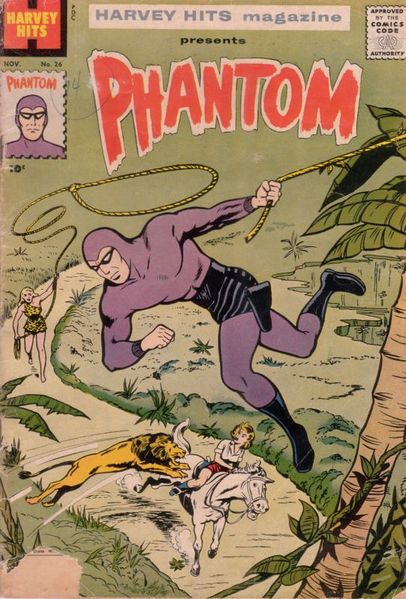
Joe Simon’s involvement with the Phantom is less well-known but remains a fascinating part of his career. the Phantom, created by Lee Falk in 1936, was one of the first costumed heroes in comic strips. While Simon didn’t create the character, he contributed to various Phantom comic book stories, particularly in the 1950s and 1960s, when publishers such as Harvey Comics and Charlton Comics adapted the character for comic books. His work on the Phantom maintained the pulpy, action-packed style he was known for, aligning with the mysterious, globetrotting adventures of the character.



By the 1960s, the comic book industry was undergoing major changes, with superheroes regaining popularity thanks to the rise of Marvel Comics under Stan Lee and Jack Kirby. Simon, however, shifted away from the superhero genre, focusing instead on publishing and editing. He briefly returned to DC Comics, working on Brother Power, The Geek in 1968, a short-lived and eccentric title about a sentient mannequin that became a counterculture hero. The series lasted only two issues before being canceled, reportedly due to disapproval from DC management.
In the 1970s and 1980s, Simon’s role in the industry became more historical, as he wrote about his experiences and helped document the history of comics. He published The Comic Book Makers in 1990, a memoir detailing his time in the industry, his collaborations with Jack Kirby, and the inner workings of Golden and Silver Age comics. Simon also worked with Marvel to reintroduce Captain America to new audiences, occasionally consulting on special projects related to the character.
Joe Simon’s legacy was further cemented when he was inducted into the Will Eisner Comic Book Hall of Fame in 1999. His contributions to the industry, from co-creating one of the most enduring superheroes in history to pioneering new comic book genres, made him one of the most influential figures in comics. His partnership with Jack Kirby remains legendary, with their combined creative output shaping the visual language and storytelling techniques that define comic books to this day.
Simon passed away on the 14th of December 2011, at the age of 98, leaving behind a vast body of work that continues to inspire artists and writers. His influence can be seen in the success of Captain America, who remains one of Marvel’s flagship characters, as well as in the romance, crime, and horror comics he helped popularize. From superheroes to satire, Joe Simon’s impact on the comic book industry is undeniable, and his work continues to be celebrated by fans and historians alike.
 thephantom.fan