
Jan Stenmark, born in 1949, stands as one of Sweden’s most distinctive and celebrated visual artists and cartoonists. For nearly four decades, he has cultivated a unique and immediately recognizable artistic world defined by satirical collages that are simultaneously hilarious, deeply human, and subtly thought-provoking. His work achieves its impact through a clever juxtaposition of nostalgic, often saccharine, imagery and sharp, minimalist textual commentary. Stenmark has moved beyond traditional comic art to establish himself as an iconic voice in Swedish contemporary culture, whose art, though seemingly simple in technique, invites viewers to engage with multiple layers of profound and contradictory meaning.
The core of Stenmark’s distinctive style lies in his commitment to the art of collage, a technique he has mastered and personalized. His process involves meticulously selecting and utilizing old newspaper and magazine clippings, primarily sourced from the 1940s through the 1960s. These vintage images, often depicting idealized domestic scenes, advertisements, or stoic individuals, are then treated with ink and paired with short, piercing, and intensely ironic captions. This deliberate collision between the outdated, sanitized visual world and the contemporary, often existential, verbal commentary is what generates the unique satirical spark that defines his oeuvre.
Stenmark’s thematic focus delves into the absurdity and quiet desperation inherent in everyday life, establishing a strong sense of human recognition in his audience. While his work is rooted in humor and satire, it frequently carries an undercurrent of melancholy. This complex emotional balance allows the collages to transcend simple jokes; they serve as a mirror reflecting relatable feelings of isolation, societal expectation, and the failure of idealized consumerism. By taking non-politically correct risks and exposing uncomfortable truths, Stenmark’s art offers a sense of cathartic liberation, assuring the viewer that they are not alone in noticing the strange, awkward, and often painful realities of the modern world.
Before establishing his career, Stenmark solidified his artistic foundation, studying at Konstfack (the University of Arts, Crafts and Design) between 1975 and 1979. This formal education provided him with the necessary structure to develop the singular expression he would later apply to collage and visual art. His longevity in the field—approaching forty years of consistent output—underscores not only his dedication but also the enduring relevance of his artistic vision. Over the years, his works have been widely disseminated through books, calendars, and exhibitions, firmly cementing his status as a unique and important presence within the Swedish art landscape.
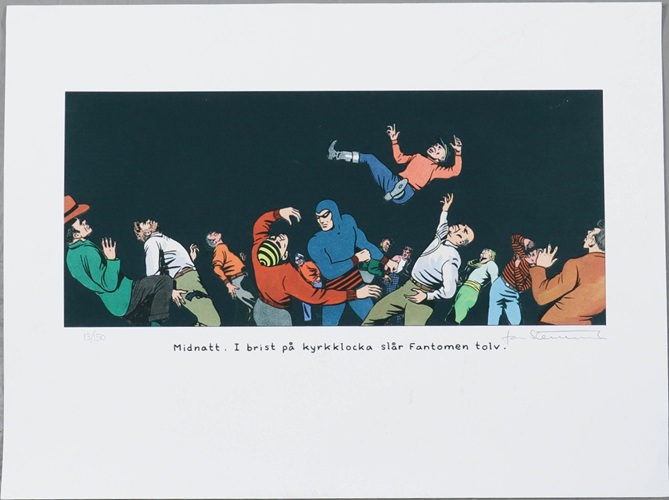
Jan Stenmark produced an illustration featuring the Phantom. It depicts a scene with twelve bad guys surrounding the Phantom with a tagline found below the image reading ‘Midnatt. I brist på kyrkklocka slår Fantomen tolv.’, which translates to ‘Midnight. In the absence of a church bell, the Phantom strikes twelve.’. The Phantom is illustrated in his Blue colored costume, as he’s published in Sweden.
Today, Jan Stenmark’s collages are highly coveted pieces, sought after by collectors and art lovers alike. His enduring popularity stems from his ability to fuse high artistic merit with accessible, resonant humor. The simple composition, the vintage charm, and the profound sharpness of his wit combine to create works that feel both timeless and acutely modern. Ultimately, Stenmark’s contribution is that of a master satirist who found a way to bridge the gap between fine art and popular culture, using paper and ink to forge a shared community built on the recognition of life’s beautiful, sometimes tragic, and endlessly ironic contradictions.
 thephantom.fan