
George Olesen, a name often whispered amongst Phantom aficionados, is a pivotal figure in the history of the Ghost Who Walks. While his name may not be as widely recognized as his contemporaries, his contribution to the enduring legacy of Lee Falk’s creation is undeniable. Olesen, a skilled artist with a deep respect for the established visual language of the Phantom, spent decades shaping the look and feel of the strip, ensuring its seamless transition into the 21st century.
Born on the 6th of December 1924 in Brooklyn, New York, USA, Olesen’s life took an early turn towards adventure. He served as a B-24 pilot in the Burma campaign during World War I, experiencing firsthand the realities of conflict and the importance of courage and resilience. These experiences undoubtedly shaped his worldview and likely influenced his artistic approach, imbuing his work with a sense of dynamism and a profound appreciation for human strength.
After the war, Olesen pursued his passion for art, earning an illustration degree from the prestigious Pratt Institute in 1949. This formal training provided him with a solid foundation in artistic principles, honing his skills in drawing, perspective, and storytelling.
Olesen’s journey with the Phantom began discreetly. He entered the world of the Phantom as an uncredited penciller, working closely with the legendary inker Sy Barry. For many years, their collaboration remained a closely guarded secret, with Barry receiving sole credit for the artwork.
This period of “ghosting” was a testament to Olesen’s dedication to the integrity of the strip. He meticulously followed Barry’s lead, ensuring that the visual style of the Phantom remained consistent with the decades-long tradition established by Lee Falk and his original artist, Ray Moore. Olesen’s role was crucial in maintaining the seamless continuity of the strip, preserving its distinctive look and feel fora new generation of readers.
When Sy Barry retired from illustrating daily Phantom comic strips in 1994, Olesen finally stepped into the limelight, receiving official credit for his work on the Phantom. He continued to collaborate with a new inker, Keith Williams through till 2005, who seamlessly complemented Olesen’s style. This partnership further solidified the visual identity of the strip, ensuring that the Phantom remained a visually captivating and engaging experience for readers.
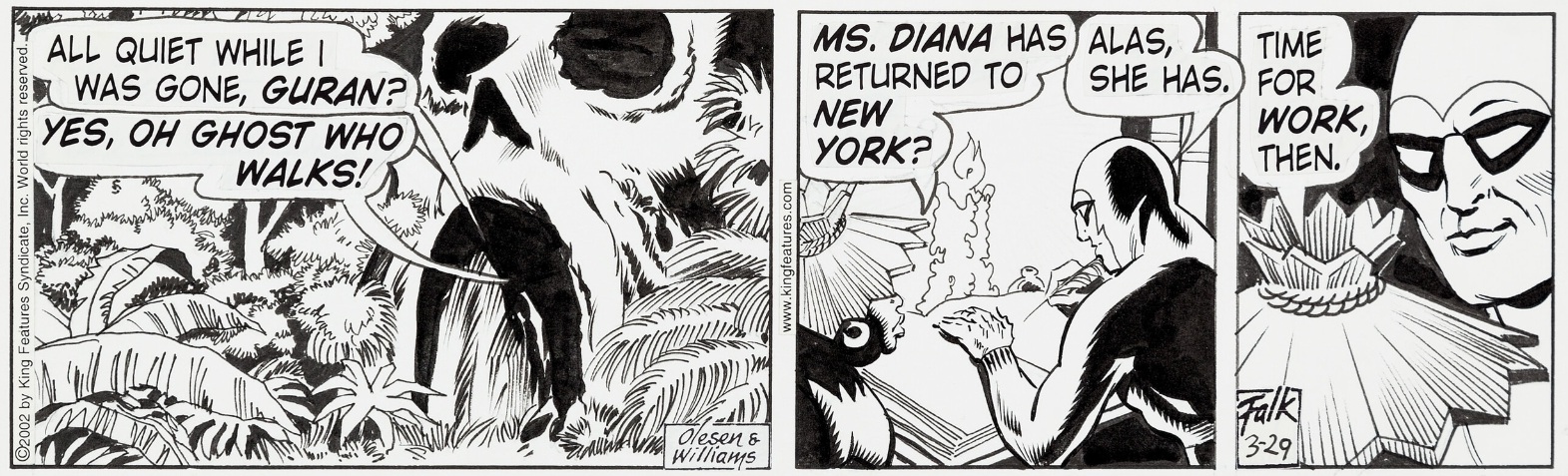
He’s credited as working on 32 daily Phantom comic strip stories from 1994 thru till 2005 and 11 Sunday Phantom comic strip stories from 1994 thru till 2000, alongside Sy Barry, Keith Williams, Fred Fredericks, Paul Ryan and Erik Doescher.
Olesen’s artwork on the Phantom can be characterized by several key elements:
- Dynamic Action: Olesen was a master of depicting movement and action. His figures were imbued with a sense of life and energy, whether they were engaged in thrilling chases, acrobatic feats, or hand-to-hand combat.
- Detailed Backgrounds: Olesen meticulously rendered the intricate details of the Phantom’s world, from the lush jungles of the Bangalla to the bustling cities of the modern world. His backgrounds were not merely backdrops; they were integral to the storytelling, adding depth and atmosphere to the adventures.
- Respect for Tradition: While Olesen brought his own unique style to the strip, he always maintained a deep respect for the established visual language of the Phantom. He carefully studied the work of his predecessors, ensuring that his interpretations remained true to the spirit of Lee Falk’s creation.
- Characterization: Olesen’s artwork went beyond mere illustration; it helped to define the character of the Phantom. He captured the character’s nobility, his unwavering commitment to justice, and his underlying humanity beneath the mask.
While the Phantom undoubtedly occupies a prominent place in Olesen’s career, he also contributed to other comic strip projects such as Sunday comic strip stories for Red Ryder and Flash Gordon. His artistic talents were diverse, and he demonstrated an ability to adapt his style to suit a variety of genres and characters.
George Olesen’s contributions to the world of comics, and to the Phantom in particular, are immeasurable. He dedicated decades of his life to preserving the legacy of this iconic character, ensuring that the Phantom continued to captivate and inspire readers around the world.
His meticulous craftsmanship, his dedication to artistic excellence, and his deep respect for the tradition of the Phantom have cemented his place as one of the most important artists in the history of the strip. While his name may not be as widely recognized as some of his contemporaries, his influence on the Phantom’s visual identity is undeniable.
A Deeper Dive into Olesen’s Phantom legacy:
- The Uncredited Years: Researching the early years of Olesen’s collaboration with Sy Barry can provide valuable insights into the evolution of the Phantom’s visual style and the importance of artistic teamwork.
- The Impact of Technology: Examining how Olesen adapted to changing technologies and techniques throughout his career can shed light on the evolution of comic book art in the latter half of the 20th century.
- Olesen’s Influence on Subsequent Artists: Analyzing the work of artists who followed in Olesen’s footsteps can help to understand his lasting impact on the visual language of the Phantom.
By exploring the life and work of George Olesen, we can gain a deeper appreciation for his significant contributions to the world of comics and the enduring legacy of the Phantom. His story serves as a reminder of the importance of artistic collaboration, the dedication to craft, and the power of art to bring timeless characters to life.
George Olesen passed away on the 15th of October 2013 at the age of 88 in Palm City, Florida, USA.
 thephantom.fan