
The landscape of Italian art has been enriched by numerous talents, often working across diverse mediums and genres. Among these, Enzo Ciacci carved a distinct niche, particularly within the vibrant world of comic book illustration. While perhaps not as widely recognized as some of his contemporaries in fine art, Ciacci’s contributions to popular culture, specifically through his compelling cover art, cemented his place as a significant figure in Italian visual storytelling.
Born in Italy, Ciacci’s artistic journey led him to become a notable illustrator, with his work gracing the covers of various publications. His most prominent association, and arguably where his artistic flair shone brightest, was with L’Uomo Mascherato, the Italian iteration of the globally beloved comic strip, the Phantom. For this iconic series, published by Fratelli Spada, Ciacci created a striking cover illustrations that captured the adventurous spirit and mysterious allure of the character. His work often executed in tempera on cardboard, demonstrate a keen eye for composition and a masterful ability to convey narrative through a single, impactful image.
Published in 1966 within the ‘I Classici Dell’Avventura’ series by Fratelli Spada in Italy, Enzo Ciacci’s talent is distinctly exemplified through the Phantom, known as L’Uomo Mascherato in Italy, as illustrated in an extraordinary underwater combat scene.
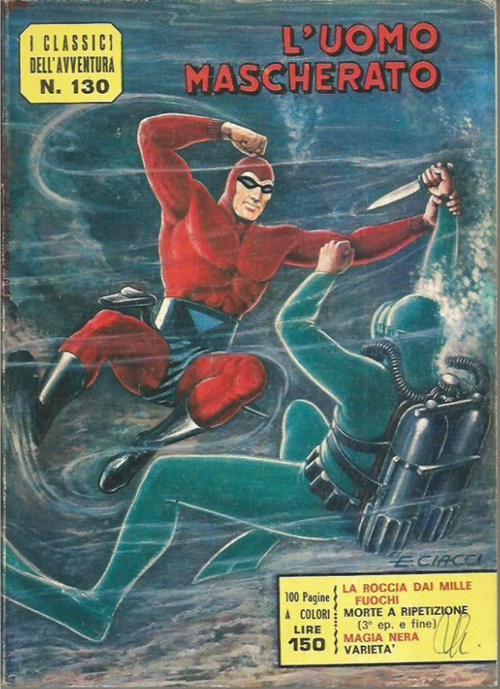
Ciacci’s artistic style, as evidenced by his comic book covers, leaned towards a dynamic and illustrative approach. He was adept at rendering figures with a sense of action and drama, essential qualities for captivating a comic book audience. His use of tempera, a medium known for its rich, opaque colors and fine detail capabilities, allowed him to create vibrant and intricate scenes that would draw readers into the world of the Phantom. While specific details on his training or broader artistic philosophy remain less documented, his professional output clearly showcases a dedication to the craft of visual narrative and a strong understanding of how to translate a story’s essence into a compelling visual.
Beyond his work on L’Uomo Mascherato, Ciacci’s career likely encompassed other illustrative projects, though these are less widely publicized. The nature of comic book art often requires artists to be versatile, capable of adapting their style to different characters and genres. His contributions were vital in shaping the visual identity of popular comics in Italy during his active period, helping to popularize characters and stories that resonated with a wide readership. Enzo Ciacci’s legacy, therefore, lies in his skilled artistry and his enduring impact on the visual culture of Italian comic books, a testament to the power of illustration in capturing imaginations and bringing beloved heroes to life.
 thephantom.fan