
Donne Avenell (11th September 1925 – November 1996) stands as one of the most prolific and versatile architects of the British comic industry’s golden age. Born in Croydon, Surrey, United Kingdom, Avenell’s career trajectory followed a classic path for post-war British writers: beginning as an assistant editor at Amalgamated Press before serving in the Royal Navy during World War II.
Upon his return, he transitioned into a freelance writer, ultimately crafting thousands of scripts across genres ranging from gritty war stories and supernatural thrillers to post-apocalyptic adventures and high-fantasy sagas. His ability to adapt his voice to various markets allowed him to find success not only in the United Kingdom but also in Scandinavia and Nigeria.
Avenell’s early career was defined by his contributions to the legendary Fleetway and IPC weeklies. He became a staple writer for titles like Lion, Valiant, and Tiger, where he helped define the “anti-hero” and “supernatural” archetypes of British comics. Among his most celebrated creations was the immortal Adam Eterno, a man cursed to wander through time, and the eerie Dr. Mesmer’s Revenge.
He also contributed significantly to the War Picture Library, famously collaborating with the Italian master Hugo Pratt on stories like Battle Stations. In 1975, he showcased his international range by co-writing Powerman, a superhero series produced for the Nigerian market, which notably featured early professional artwork by industry icons Dave Gibbons and Brian Bolland.
His work on the Phantom began in 1978 and represents one of the most creatively significant periods of his life. Writing for the Swedish publisher Semic (later Egmont), Avenell joined the “Team Fantomen” writing crew at a time when the character was expanding beyond its American newspaper roots into more complex, long-form stories. Avenell was praised by fans for his deep respect for the Phantoms’ mythology while injecting a modern, darker sensibility into the stories. He excelled at blending historical lore with contemporary action, often focusing on the internal moral compass of the Phantom.
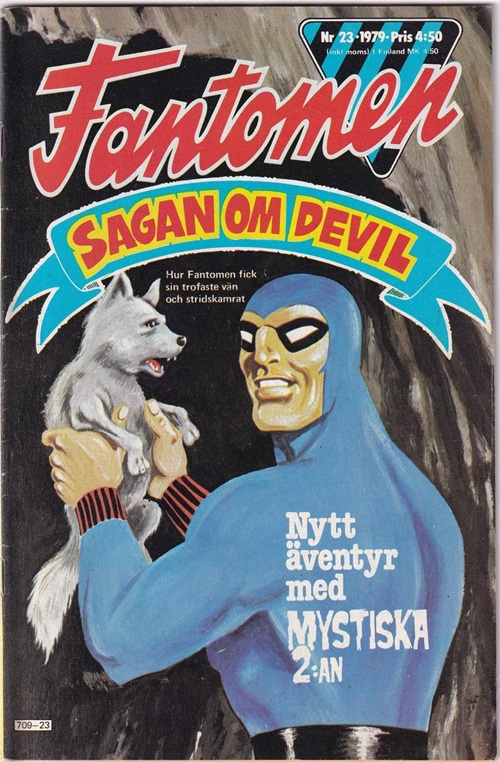
Avenell’s contribution to the Phantom mythos is perhaps best exemplified by the 1979 story, “The Story of Devil” (published in Fantomen edition number 23 by Semic Press). Frequently voted by fans as one of the greatest Phantom stories ever told, it provided a poignant and definitive origin for the hero’s loyal wolf companion. Avenell’s writing for the series was characterized by a cinematic pace and an emphasis on the Phantom as a symbol of justice rather than just a costumed vigilante. Over nearly two decades, he penned 69 Phantom stories, becoming one of the most influential writers in the character’s international history.
Beyond the Phantom, Avenell achieved mainstream success with the newspaper strip Axa, which debuted in The Sun in 1978. Created alongside artist Enrique Badía Romero, the strip followed a courageous woman navigating a savage, post-holocaust world. Avenell’s scripting for Axa was lauded for its blend of social commentary, survivalist action, and strong characterization, ensuring the strip’s survival for nearly a decade. Despite his passing in 1996, Avenell’s legacy remains vibrant in 2025; recent archival efforts, such as the restoration of his and John M. Burns’ strip Eartha, continue to introduce his storytelling mastery to new generations of readers through the Eartha Collection project.
 thephantom.fan