

Aslan Şükür, born on February 10, 1945, in the town of Bafra, Turkey, grew up in a modest household where his fascination with art began at an early age. Despite facing economic challenges and lacking formal education in art, Şükür pursued his passion relentlessly. He was influenced heavily by prominent Turkish cartoonists like Remzi Türemen and Nehar Tüblek, whose dynamic and engaging illustrations served as an early inspiration for his career.
In 1962, his family moved to Istanbul, a city that would become pivotal in shaping his artistic career. Immersed in Istanbul’s burgeoning publishing scene, Şükür found work with Tay Yayınları in the 1970s. This partnership would become one of the most fruitful collaborations in Turkish comic art history.
The Artistic Style of Aslan Şükür
Aslan Şükür’s artistic style was marked by a vivid use of color, dramatic compositions, and a keen eye for detail. He possessed an exceptional ability to capture action, emotion, and narrative tension in a single frame, making his works visually compelling. His covers often featured bold, dynamic scenes that placed characters in the heat of action—whether it was a dramatic jungle chase, an intense battle, or a tense face-off.
Şükür’s style was deeply cinematic. His ability to convey motion through the placement of characters and the use of perspective gave his illustrations a lively, almost three-dimensional quality. His compositions often employed triangular or diagonal arrangements, ensuring that the viewer’s eyes were drawn to the central elements of the scene.
One of his distinctive techniques was the use of lighting and shadows to create atmosphere. His darker works, especially those for adventure and crime comics, featured moody chiaroscuro effects that added depth and drama. For adventure comics like Kızılmaske, the interplay of light and shadow enhanced the exotic and mysterious settings, lending authenticity to the scenes.
Collaboration with Tay Yayınları
Tay Yayınları, a prominent Turkish publishing house, played a crucial role in Şükür’s career. His collaboration with them began in the early 1970s, during which he created covers for numerous comic books, including Zagor, Mister No, Tom Braks, Apo, Mini Ringo, Atlantis, Martin Mystere, Alaska, Ken Parker, Jeriko, Jil, Judas, Kızılmaske, Mandrake the Magician, Karaoğlan, Teksas, Tommiks, and Flash Gordon. His versatility across genres—from Westerns and jungle adventures to space operas and crime mysteries—showcased his adaptability and artistic range.
Şükür’s ability to produce high-quality covers quickly earned him the trust of publishers, who often relied on him for tight deadlines. His studio reportedly resembled a production line, where he could turn out several paintings in rapid succession without compromising on detail or quality.
While Tay Yayınları was his primary collaborator, Şükür also worked with other publishers, including Nile Publications, Golden Books, and Revolution. He extended his creative touch to children’s books, posters, and even Turkish adaptations of James Bond novels. These projects allowed him to experiment further with his style, blending realism with fantastical elements to cater to different audiences.
Redefining The Phantom as Kızılmaske

Şükür’s most iconic work remains his adaptation of the Phantom, known in Turkey as Kızılmaske. The character, originally created by Lee Falk in 1936, was reimagined by Şükür for a Turkish audience. Notably, he changed the color of the Phantom’s costume from purple to red, reflecting a cultural preference and aligning with the character’s new name, which translates to ‘Red Mask’.
This change was not merely cosmetic; it was a conscious effort to make the character more relatable and heroic in the context of Turkish culture during the 1970s. Purple, often associated with regality or softness in Turkey, was considered unsuitable for an action hero. The red costume, by contrast, exuded strength, energy, and defiance, qualities central to the character’s identity as a masked avenger.
Şükür’s covers for Kızılmaske often featured the hero in action-packed scenarios, fighting adversaries or navigating dangerous terrains. These covers encapsulated the essence of the Phantom’s duality—his role as a fierce warrior and a protector of justice. The lush jungles, treacherous cliffs, and vibrant skies that formed the backdrops of these scenes were as much a testament to Şükür’s artistic vision as the hero himself.
Mediums and Techniques
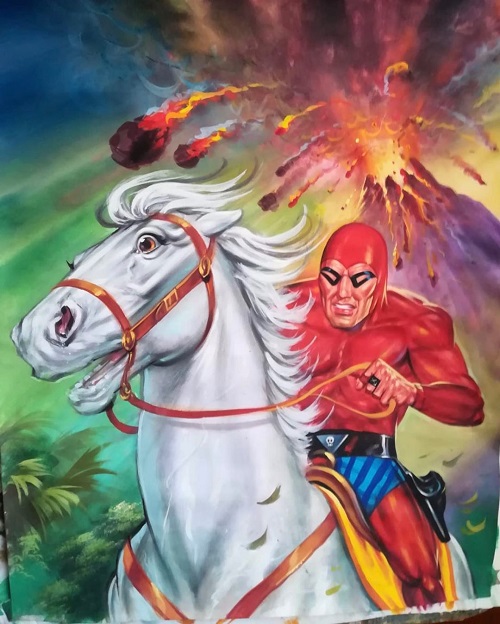
Şükür primarily worked with gouache paint, a medium that allowed him to achieve the vibrant, opaque colors and fine details characteristic of his illustrations. Gouache, with its rich, matte finish, provided the perfect medium for creating the dynamic, visually arresting covers for which he was famous.
He often began his process with pencil sketches, meticulously laying out the composition and ensuring the proportions and perspectives were accurate. Once the sketch was finalized, he transferred it to a thicker paper or board suitable for gouache painting. The choice of gouache also enabled him to layer colors effectively, achieving gradients, highlights, and textures that brought his scenes to life.
In addition to gouache, Şükür occasionally used ink for finer detailing, particularly in scenes requiring intricate line work. For instance, in depictions of jungle foliage or the folds of costumes, his delicate ink work complemented the bold strokes of his gouache paintings.
Recognition and Publications
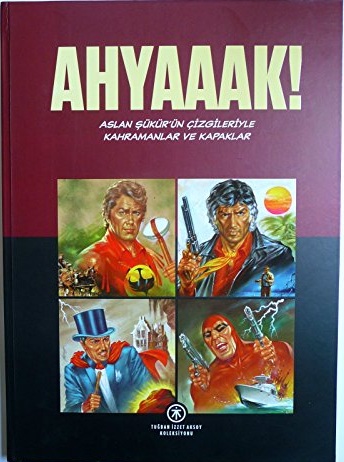
‘Ahyaaak! Aslan Şükür’ün Çizgileriyle Kahramanlar ve Kapaklar’ is a comprehensive art book that showcases the works of Turkish cover artist Aslan Şükür. Published in 2014 by D Yayinevi in Istanbul, this folio-sized hardcover spans 150 pages and includes numerous color illustrations, along with three folding plates.
The book is a curated collection from the Tuğban İzzet Aksoy Collection, with editorial contributions by Ömer Atakan. It offers an extensive overview of Şükür’s prolific career, highlighting his dynamic cover art for various comic books and posters that significantly influenced Turkish pop culture.
Limited to 750 copies, Ahyaaak! serves as a valuable reference for enthusiasts of Turkish comics and illustration, providing insight into Şükür’s artistic process and his contributions to the visual landscape of Turkish media. The title Ahyaaak! reflects the dynamic and energetic style that Şükür brought to his artwork, capturing the essence of the heroes and covers he illustrated throughout his career.
Passing and Posthumous Acknowledgment
Aslan Şükür passed away on the 10th of April 2022, but his legacy endures through his art. His works remain highly sought after by collectors and are celebrated in exhibitions and publications. His dynamic, colorful covers continue to inspire a new generation of Turkish artists, ensuring that his contribution to the world of comics is neither forgotten nor diminished.
Conclusion
Aslan Şükür’s career is a testament to the impact of cultural adaptation and artistic innovation in the world of comics. His work on Kızılmaske not only redefined a beloved character for Turkish audiences but also showcased the importance of cultural relevance in storytelling. Through his collaborations with various publishers and his dedication to his craft, Şükür has left an enduring legacy that continues to influence the comic art landscape in Turkey and beyond.
 thephantom.fan