
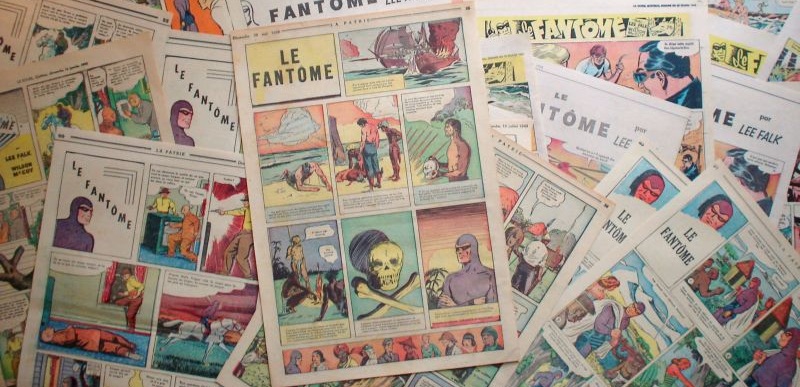
The Phantom has consistently captivated audiences worldwide for nearly a century. His traditional and iconic portrayal, characterized by a skin-tight purple suit and a concealed eye mask, alongside his interactions with distinctive characters, his residence in the jungle of Bangalla, and his steadfast commitment to justice, have transcended cultural and linguistic boundaries, establishing him as a genuinely global hero.
The success of the Phantom across various regions can be attributed significantly to the ingenuity and dedication of translators and publishers who have brought his stories to life in numerous languages and cultural contexts, all under the auspices of King Features Syndicate. These translations represent not merely linguistic exercises but rather acts of storytelling adaptation, meticulously crafted by local publishing houses to resonate with local audiences while maintaining the core essence of the Phantom’s character.
In Scandinavia, clad in a blue costume, the Phantom is known as Fantomen. Sweden, Norway, and Finland have embraced the Ghost Who Walks with unparalleled enthusiasm, making the region one of the character’s most devoted fanbases. In Sweden, publishers like Egmont have not only translated the original stories but also commissioned exclusive stories that delve into Nordic mythology and themes, amongst other topics. This localization has allowed the Phantom to feel both familiar and relevant to Scandinavian readers.
Across Europe, translations of the Phantom have adapted the character to suit regional sensibilities, published wearing a red costume. In Italy, he is known as L’Uomo Mascherato, or ‘The Masked Man’. Italian publishers often highlighted the romantic and adventurous aspects of the Phantom’s stories, appealing to readers’ love for drama and intrigue. In France, where he is referred to as Le Fantôme du Bengale, his jungle exploits have been interpreted with a sense of exoticism, reflecting French literary traditions that romanticize far-off lands and cultures. These adaptations demonstrate how the Phantom has been tailored to fit the storytelling traditions of each country, making his adventures universally relatable.
In India, the Phantom is known as Vetaal, a name derived from Hindu mythology that instantly resonates with local audiences, printed in his traditional purple costume. The character’s stories were first introduced through Indrajal Comics, which translated the original strips into several regional languages, including Hindi, Tamil, Bengali, and Marathi. This wide linguistic reach ensured that the Phantom became a household name in one of the world’s most linguistically diverse countries. Indian adaptations often localized dialogue and cultural references, making the stories feel more immediate and engaging to readers. For example, the Phantom’s moral code and his fight against corruption mirror values deeply embedded in Indian society, endearing him to millions.
In South America, El Fantasma has found a stronghold in countries like Brazil and Argentina, commonly published wearing a red costume. Latin American publishers have embraced the Phantom’s tales with vibrant illustrations and serialized storytelling styles. These adaptations often emphasize family and community, aligning with cultural values prevalent in the region. The Phantom’s sense of justice and his role as a protector resonate strongly with audiences who admire his unwavering dedication to fighting oppression. The serialized format also allows for dramatic cliffhangers and character development, which are hallmarks of popular storytelling in Latin America.
The Phantom’s translations are not limited to language; they also encompass cultural adaptation. This process involves reinterpreting the character’s actions, settings, and values to align with the expectations and norms of different audiences. In some regions, this has meant softening the portrayal of violence or emphasizing themes of family and community. In others, it has involved incorporating local folklore or historical elements to give the stories a sense of place. Such adaptations ensure that the Phantom remains accessible and relevant, even as he traverses vastly different cultural landscapes.
One of the most striking aspects of the Phantom’s global journey is how his persona adapts while his core values remain unchanged. Regardless of the language or cultural context, the Phantom is consistently portrayed as a figure of justice, compassion and resilience. His commitment to protecting the innocent and his respect for the traditions of Bangalla serve as a unifying thread that connects his diverse adaptations. This consistency is a testament to the universality of the character and the timeless appeal of his principles.
In recent years, digital platforms have played a crucial role in bringing the Phantom to new audiences. Social media has played a critical role, opening the dialect for discussion on various aspects of the Phantom, his stories and his mythos. Heated discussions are often seen on varying views on any particular topic, reflecting the passion felt by his fanbase, often expressing their points-of-view with vigor. The digital age has also facilitated an ease with which communication between artists and fans can occur across the globe, with creators often open to discussions and interactions about their work on the Phantom, or even providing art commission opportunities..
The success of the Phantom in translation underscores the power of storytelling to bridge cultural divides. His adventures, though rooted in a specific fictional setting, speak to universal themes that resonate with readers everywhere. The challenges he faces—battles against corruption, greed, and tyranny—are issues that transcend borders and time periods. Similarly, his virtues—integrity, courage, and compassion—are qualities admired across cultures. These universal elements make the Phantom a hero who belongs to the world, even as he is reimagined through the unique lenses of different regions.
As the Phantom approaches a century of storytelling, his global journey continues to inspire and captivate audiences. Each new translation and adaptation adds to the richness of his legacy, whether he is battling pirates in Scandinavia, defending the innocent in India, or outwitting villains in Latin America, the Phantom’s adventures remind us of the enduring power of courage and justice.
Through the dedication of global creators and publishers, and the continued support of his readership base, the Phantom’s legacy will certainly go on for many years to come!!!
Discover more from
Subscribe to get the latest posts sent to your email.
 thephantom.fan